
Four hundred years, briefly.
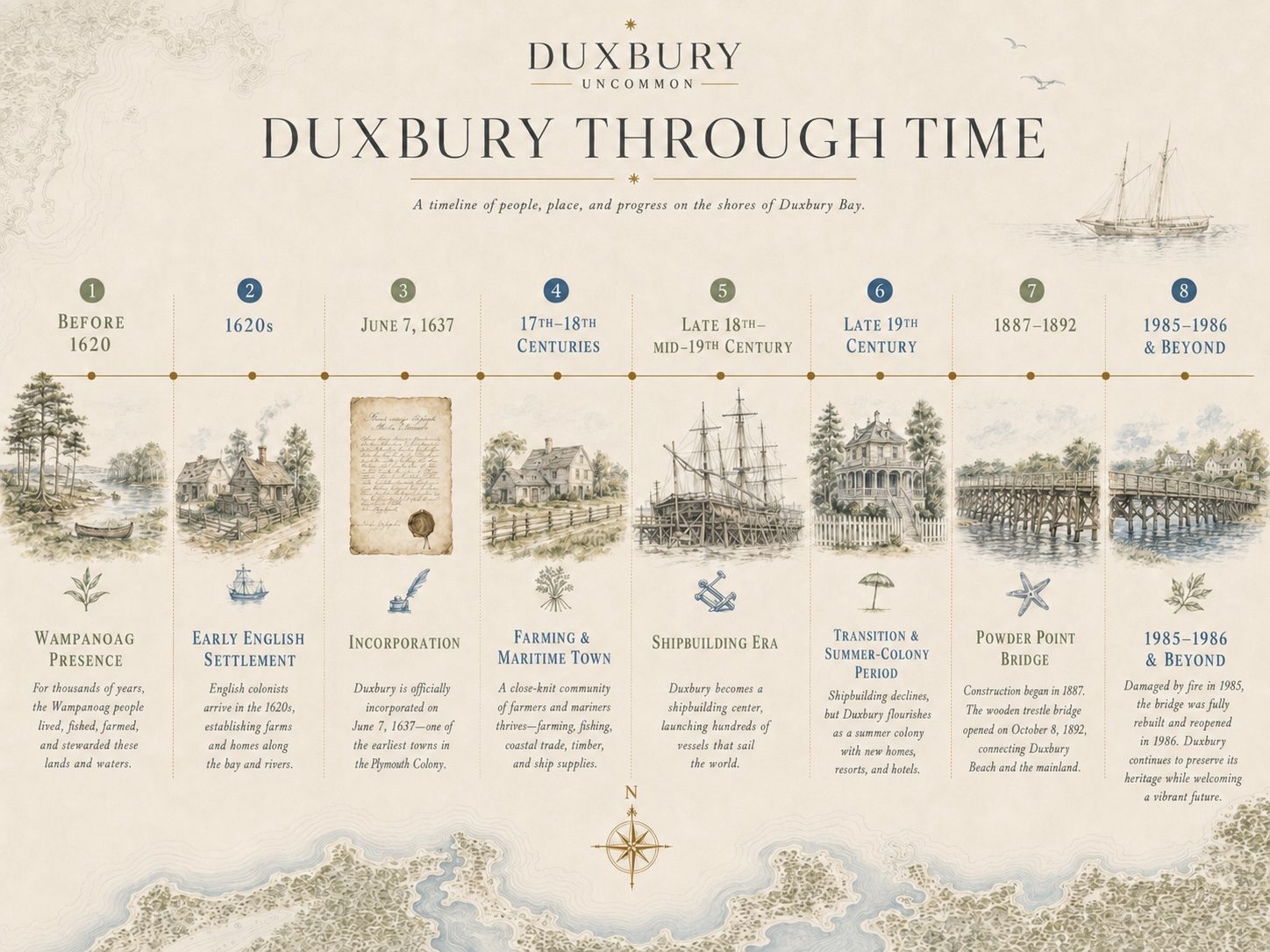
Plymouth Colony's second town. Home of Standish and Alden. Then the shipbuilding boom, the bust that froze the town in amber, and the quiet century that saved it. The short version, with the long one on its way.
The Wampanoag homeland
The land along the bay was inhabited for thousands of years before European settlement; archaeological sites in town date back millennia, and the Massachusetts Historical Commission has documented dozens of them.
Pilgrims cross the bay
Mayflower passengers Myles Standish and John Alden take land grants north of Plymouth along the bay. Standish names the settlement after Duxbury Woods near his English hometown of Chorley, Lancashire.
Plymouth Colony's second town
Duxbury incorporates, reckoned the second town of Plymouth Colony, its congregation gathered as the colony's second church as early as 1632. A detailed, year-by-year account of these founding decades covers everything from land grants to King Philip's War. For its first two centuries it stays a quiet farming and fishing community; the first school opens in 1670.
The captain is buried here
Myles Standish dies at his farm below the hill that still carries his rank. The colony's soldier had spent his last decades as a Duxbury farmer, magistrate, and colony treasurer, and he is buried in the Old Burying Ground on Chestnut Street.
The last of the Mayflower generation
John Alden dies at his Duxbury homestead, among the last survivors of the Mayflower's passengers. Longfellow's love triangle aside, his real legacy is duration: decades of service to the colony and a house site his descendants kept for centuries.
Revolution on the doorstep
Duxbury men muster at the Lexington alarm, and colonial officers hold a council of war at the Alden homestead. In the years prior, crowds burned effigies of British officials on Captain's Hill. A detailed, year-by-year account covers the town's two recanting Loyalists, its Continental Army companies, and the private who enlisted at thirteen.
The shipbuilding boom
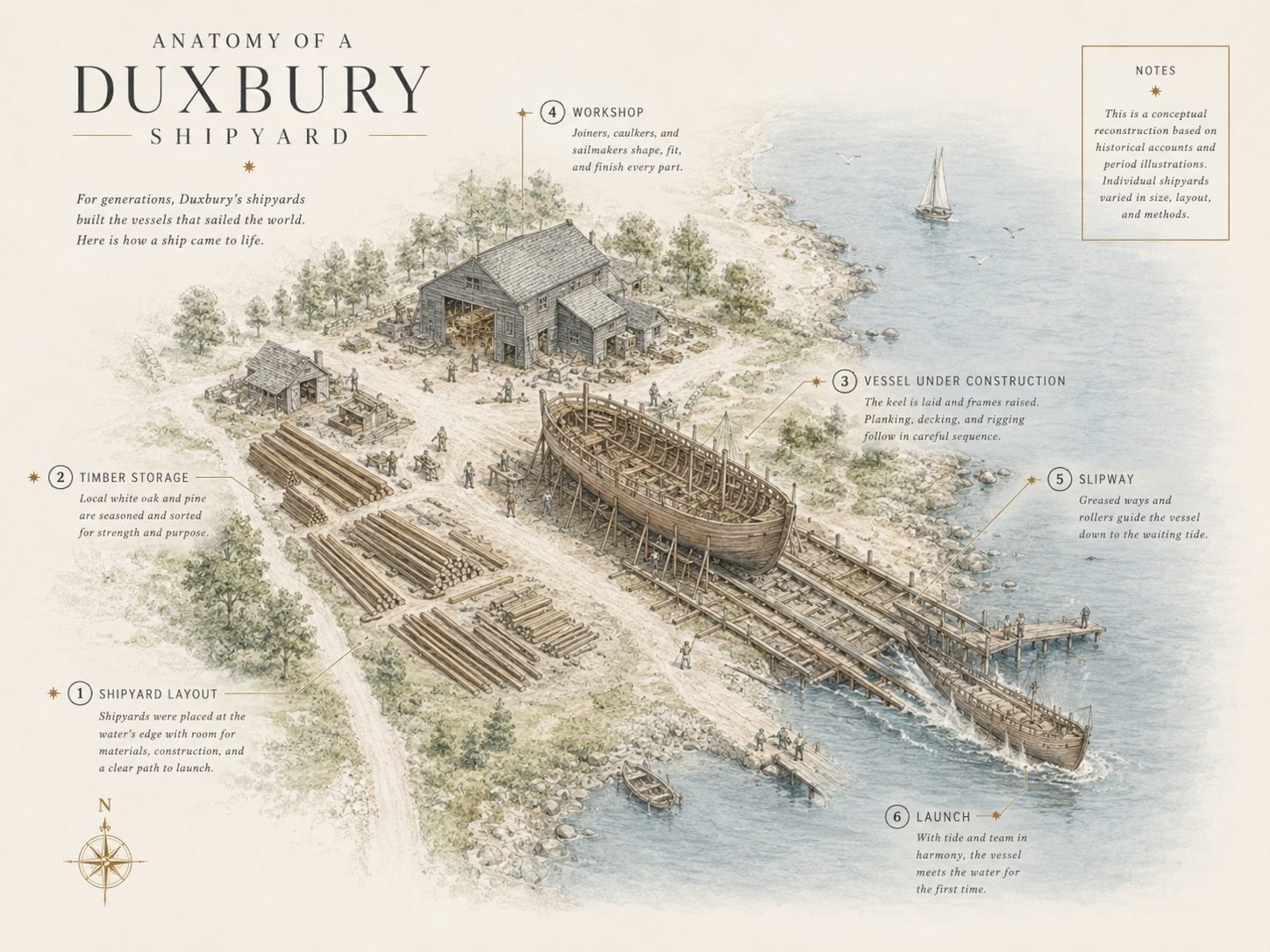
After the Revolution, Duxbury explodes into one of the great shipbuilding centers of the New World: roughly 20 shipyards, some 180 vessels, and the Weston family's merchant fleet ranking among the largest anywhere. The grand homes along Washington Street and Powder Point date to this golden age; the finest of them, the King Caesar House, is now a museum.
The bust
Steamships and railroads make Duxbury's wooden sailing vessels obsolete almost overnight. The yards close, families leave to find work, and the population falls by nearly half over the century. The hard times froze the town's streetscapes in place, and by the time summer visitors and preservationists arrived, Duxbury's golden-age architecture was still standing to save.
The railroad arrives
The Duxbury & Cohasset Railroad opens in August with three stops in town, and Boston is a $1.50 round trip away. Boarding houses and hotels multiply, and the summer resort era begins. The line runs until 1939.
A monument on Captain's Hill
A crowd of 10,000 watches the cornerstone laid for the Standish Monument. The money runs out partway up the shaft, and the 116-foot tower is not finished until 1898; look closely and the change in granite is still visible about halfway up.
Saving the town
Concerned residents found the Duxbury Rural Society (today the Duxbury Rural & Historical Society) to 'improve and ornament' the fading town. It still maintains the historic house museums and some 140 acres of conservation land.
The bridge
The Powder Point Bridge opens, connecting the mainland to the barrier beach. At roughly half a mile it is often called one of the longest wooden bridges in the country, and it still carries beachgoers today (see the beach guide).
The Portland Gale
The deadliest New England storm of the century wrecks the coast and batters the model cottages built to sell house lots on Duxbury Beach. The developers retreat, and the association formed in the aftermath survives as the Duxbury Beach Reservation, which is a large part of why the barrier beach remains undeveloped today.
The suburb by the sea
Route 3 opens in the early 1960s and puts Boston within commuting range. The population booms, and the town moves early on one-acre zoning to manage the growth.
The bridge, twice
Fire damages the Powder Point Bridge in 1985, and the repair work reveals how far the old timbers had deteriorated. The town rebuilds it in the same wooden style, and the new bridge opens on August 29, 1987.
Oysters, from scratch
Skip Bennett plants the first farmed oysters in Duxbury Bay, a bay with no wild oyster population and no promise one would take. It took. Island Creek goes full time around 2000 and puts Duxbury on menus nationwide.
Village feel, ocean address
Modern Duxbury is a residential town with a village feel, known for schools, the beach, oyster farming, and one of the best-preserved historic centers on the coast.
Deeper reading
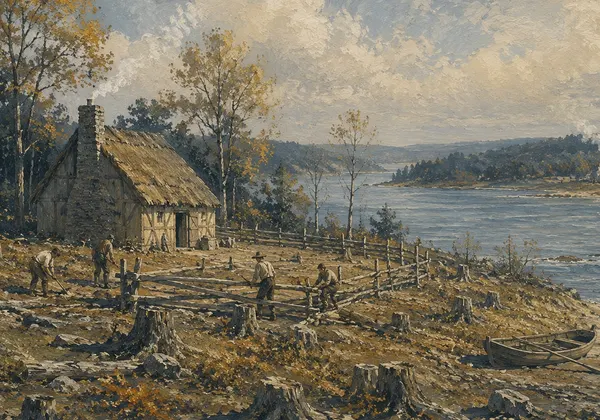
The Pilgrim Years
A detailed, year-by-year timeline of Duxbury's first sixty years: land grants, incorporation, a near-merger with Plymouth, and King Philip's War.
02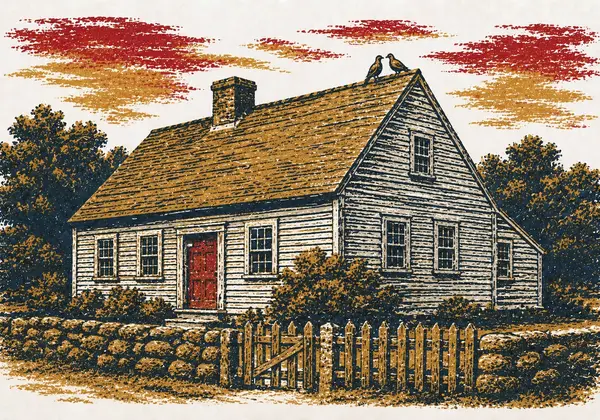
The Other Founders
Standish and Alden get the monuments. A Walloon refugee's son, a governor's stepson, and the family that vanished actually built the place.
03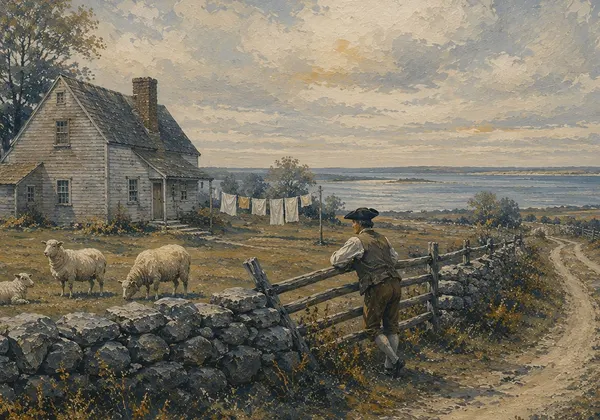
The Quiet Century
Ninety years between King Philip's War and the Revolution: a wolf bounty, a lighthouse, and the first vote to protect the beach.
04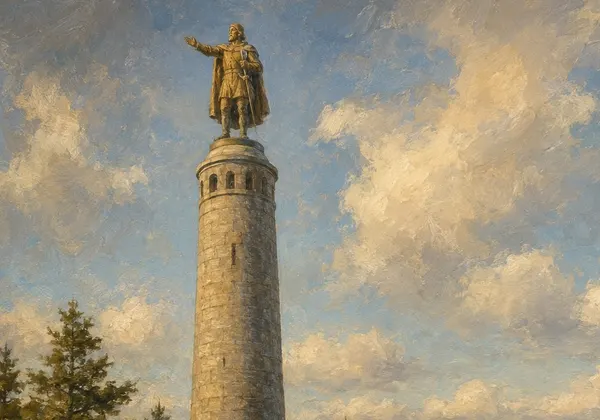
The Revolutionary Years
A fiercely Whig town, two recanting Tories, and the private who enlisted at thirteen: Duxbury's Revolution, in detail.
05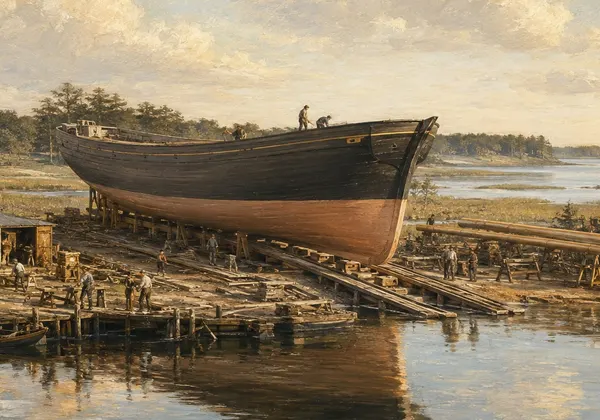
King Caesar
The Westons of Powder Point, the ship Hope, and how a shallow-bay town briefly held America's largest merchant fleet.
06The Courtship of Myles Standish
The 1858 poem that made three Duxbury founders famous, and what the record actually shows.
07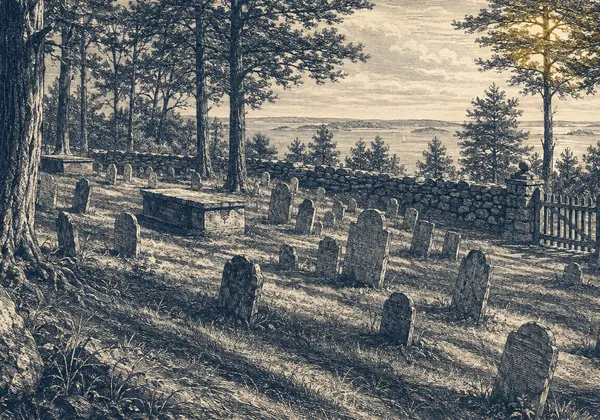
The Old Burying Ground
Built 1638, abandoned by 1789, forgotten for a century: how a family plot became the oldest maintained cemetery in the country.
08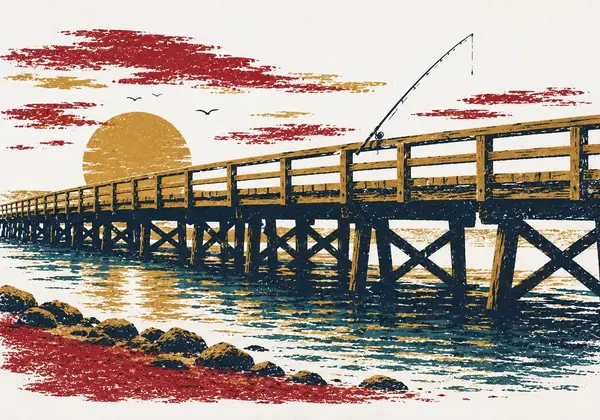
The Powder Point Bridge
Built 1892, burned 1985, rebuilt 1987, and now at the center of a fight over its future.
09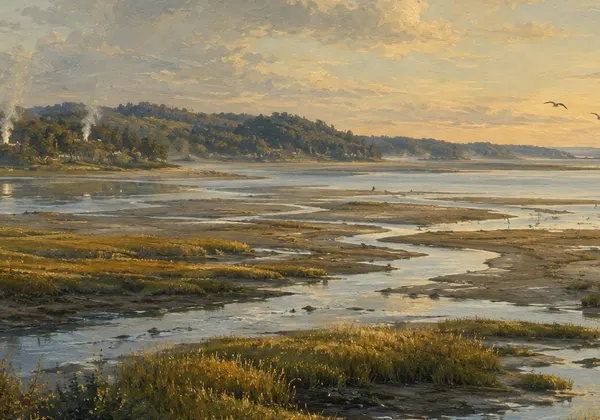
Mattakeesett
Ten thousand years of Native history on this shore, told plainly: the place of many fish, the Great Dying, Clark's Island, and the Nation still here.
10Myles Standish, the actual soldier
The hired sword of Plymouth Colony, the Wessagusset killings, and the farmer of the Nook. The record without the varnish.
11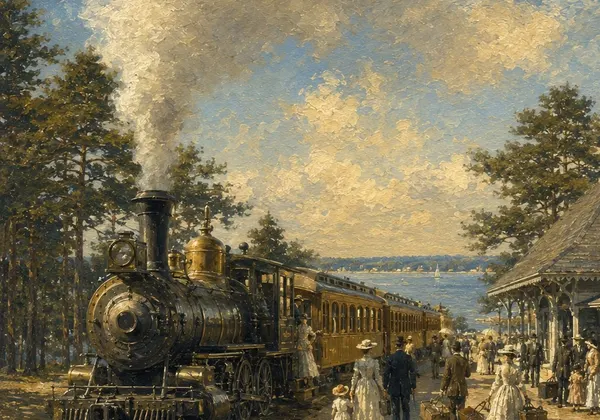
The summer resort era
How an 1871 railroad, a $1.50 ticket, and a grand hotel rescued a dying town and invented modern Duxbury.
12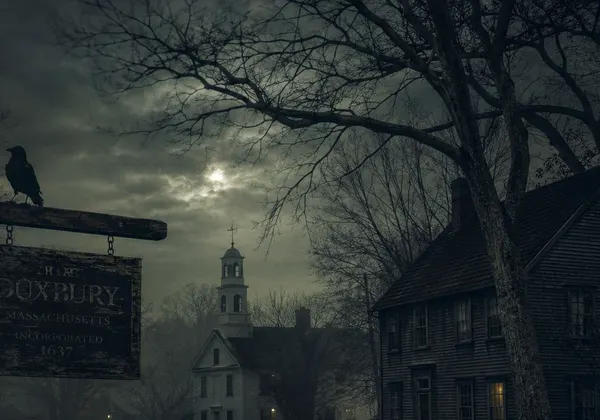
Duxbury after dark
The grave dug up three times, the feud it caused, and the tavern with a resident who never checked out. Fact and folklore, labeled.
13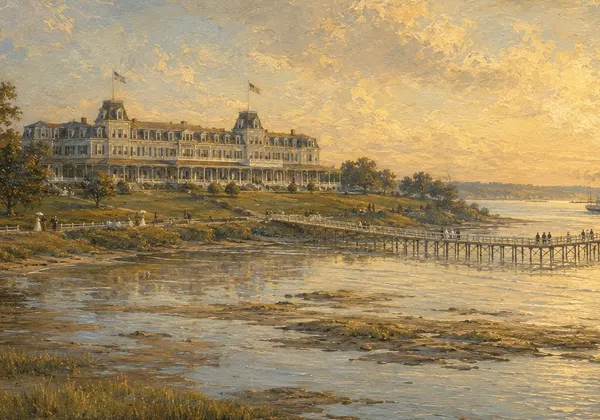
Lost Duxbury
A grand hotel, two vanished schools, twenty shipyards, and a real railroad: five things that were once central to town and are now completely gone.
14Village Names
Sodom, Ashdod, Weechertown, Tarkiln, and Tinkertown: the neighborhood names Duxbury used to have, and the one that's newer than it sounds.
15Famous residents
Compact signers, a Salem fugitive, the Silent Spring letter, and the guitarist from Aerosmith: four centuries of notable Duxbury names.
Then & now
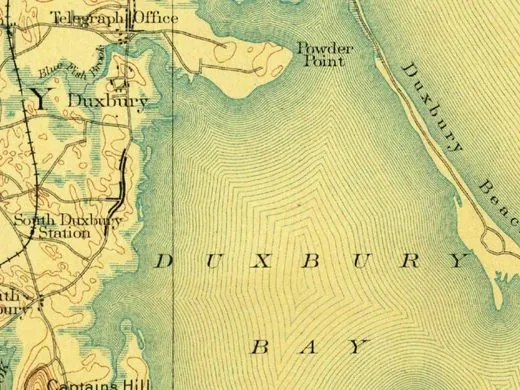
Four USGS survey sheets layered over today's aerial photo. Slide between centuries and watch the bridge appear.
Mattakeesett
Ten thousand years of Wampanoag history on the bay: the place of many fish.
Folklore
The sea serpent, the tentacled gravestone, and the rest of the town's legends, actually told.
King Caesar
Ezra Weston II, the ship Hope, and the fleet that briefly made a small town famous.