
Before Duxbury, there was Mattakeesett.
People lived on this shore for at least ten thousand years before a single English farm existed here. Their name for it meant "place of many fish." This is their story, told as plainly as the record allows.
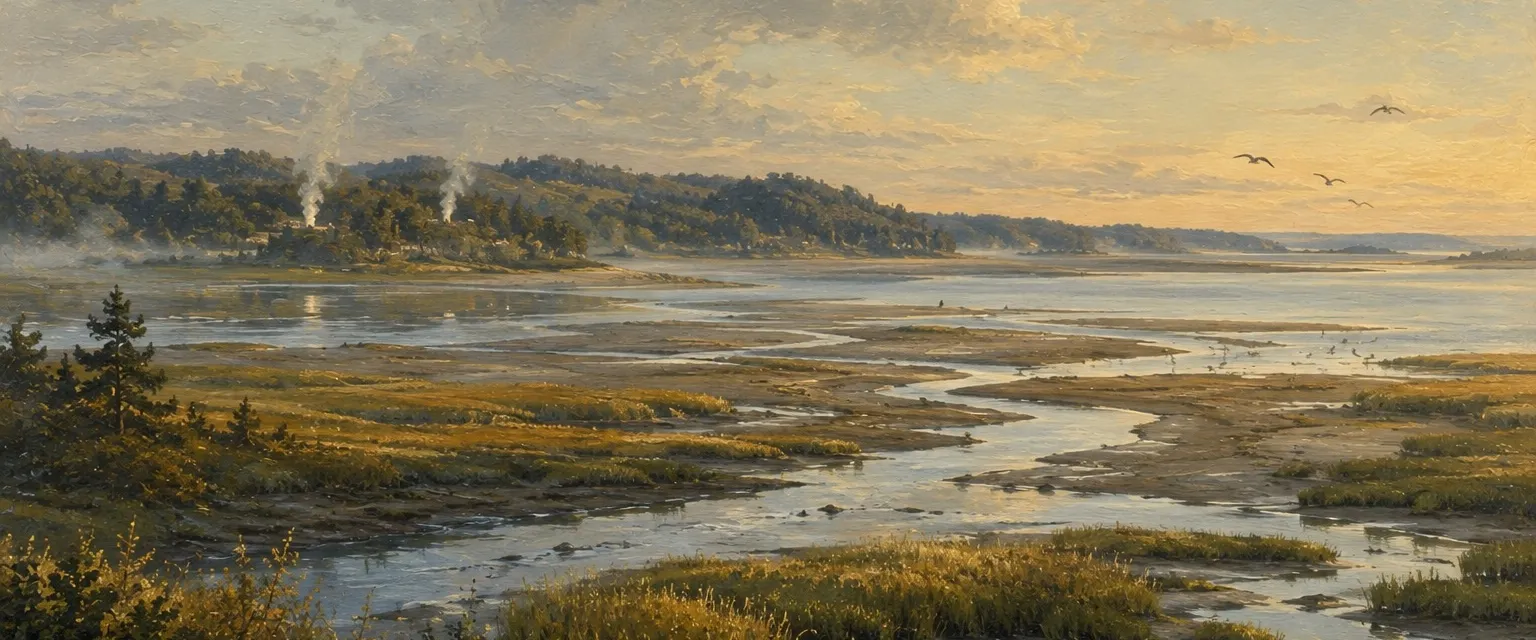 Mattakeesett, place of many fish · Duxbury Uncommon illustration
Ten thousand years
The land now called Duxbury has been inhabited since roughly the end of the last Ice Age. The Massachusetts Historical Commission counts 33 archaeological sites within town limits, and a 2012 dig on the old Brewster property turned up a stone gouge from the Late Archaic era, several thousand years before the pyramids. The attraction was obvious then and still is: fresh water, over three thousand acres of wetlands, extensive tidal flats thick with shellfish, and runs of herring in the brooks each spring. The people here named the place for what it gave them. Mattakeesett: place of many fish.
The world the settlers walked into
The people of Mattakeesett were part of the interconnected Native world of this coast; town and historical society accounts describe them as Wampanoag, while other histories tie the name to a related Massachusett community, a reminder that the neat tribal boundaries on modern maps are a simplification. They farmed cleared fields, hunted, fished, and moved seasonally between the shore and inland camps along trails that English settlers later followed and that survive today as several of Duxbury's roads.
Then, between roughly 1616 and 1619, epidemics brought by European ships killed an estimated 80 to 90 percent of the Native population along this coast. It is among the most catastrophic mortality events in recorded history, and it happened here, on this shore, in the span of a few years. When Plymouth's settlers spread north into Mattakeesett in 1627, the cleared fields waiting for them were not wilderness. They were the farmland of a society that had just been all but destroyed.
That same interconnected world did not only suffer epidemic. In 1623, four years before Plymouth's settlers reached Mattakeesett, the man who would help found Duxbury led a raid that killed several Massachusett men up the coast at Wessagusset, now Weymouth. Standish's own colony called it a rescue; the accounts preserved by Massachusett descendants call it a massacre. Both versions of that story, argued side by side, are on our profile of Myles Standish, the soldier.
Clark's Island
The darkest chapter came two generations later. During King Philip's War in 1675 and 1676, colonial authorities, fearing an uprising, forcibly removed Native people, including men and boys of the Mattakeeset community, to internment on Clark's Island in the bay. Held through the winter without adequate shelter or food, many perished there. How many is unknown; the colony kept no records of them. Descendant accounts hold that hundreds may have died. The island sits in plain view of the Duxbury shore.
Still here
Duxbury's own Native population never recovered, and for centuries only a handful of Native residents appear in town records. But the people did not vanish. The Wampanoag Nation continues in southeastern Massachusetts today, including the Mashpee Wampanoag and Herring Pond Wampanoag communities, and descendants of the Mattakeeset people maintain their own tribal organization. As Mashpee Wampanoag scholar Paula Peters put it, tribute belongs to the Wampanoag Nation, "who have been here for at least 10,000 years and who live here still." Any honest history of this town starts, and continues, with them. For where their story meets the settlers' story, see our history of Myles Standish the soldier and the town's full timeline.
Sources & verification
Drawn from the Duxbury Rural & Historical Society's Digging Duxbury archaeology pages, the Town of Duxbury Historical Commission, the Wildlands Trust's local histories, the North & South Rivers Watershed Association's account of Clark's Island, and the Mattakeeset Tribe's own published history. Where sources differ, we have said so. Spot an error? Tell us. Last verified: July 20, 2026.
The courtship, fact-checked
Longfellow made Duxbury's founders famous. What the record shows about Standish, Alden, and Priscilla.
History & heritage
Plymouth Colony's second town: the Wampanoag homeland, twenty shipyards, and the families who built it.
Folklore
The sea serpent, the tentacled gravestone, and the rest of the town's legends, actually told.