
The Uncommon 100.
Everything below is sourced, most of it from the Duxbury Rural & Historical Society, the Drew Archival Library, the National Register of Historic Places, and the Town's own records, with links back to the full story wherever one exists on this site. Nothing here is dressed up to be more dramatic than the record allows. New entries get added as new research clears the bar: surprising, and true, in that order of difficulty.
The year the world called Duxbury
01A cable came ashore here in 1869, and it was the important kind
A telegraph cable from Brest, France, by way of Newfoundland, came ashore at Rouse's Hummock on Duxbury Beach on July 23, 1869. For a few years afterward, this bay town was the American end of a direct wire to Europe.
02Six hundred people came to watch a wire land
A tent was pitched on Abrams Hill overlooking the beach, and six hundred guests, dignitaries from around the state and the world among them, gathered to watch the cable brought ashore.
03The cable brought its own immigrants
English and Canadian telegraph operators moved to Duxbury to staff the new cable office. Several of them, including the photographer William Facey, whose glass-plate images are now some of the town's most-used historical photographs, became prominent local citizens.
Shipbuilding & the sea
04The largest ship ever built here needed the tide's help to launch
The 880-ton ship Hope, launched from the Ten Acre Yard in 1841, was the biggest vessel ever built in Duxbury and the biggest merchant ship launched anywhere in Massachusetts up to that time. She was floated off the ways on an astronomical high tide, timed months ahead, because nothing that size could otherwise clear a river this shallow. The shipbuilding age →
05Ezra Weston II built his biggest ships during the worst depression the country had seen
The Panic of 1837 closed most of Duxbury's other shipyards. Weston pushed ahead anyway, launching eight vessels in five of the depression's hardest years, several of them his largest and best.
06By the 1840s, one commodity ran the whole fleet
Weston's ships, once diversified across ports and cargoes, had narrowed almost entirely onto a single route: cotton from New Orleans to Liverpool.
07Over three generations, one family shipyard built more than a hundred vessels
The Weston firm built or acquired upwards of 110 sailing vessels across three generations, ranging from the 25-ton schooner Sophia to the 880-ton Hope.
08Lloyd's of London once ranked a Duxbury man the largest shipowner in the country
At the height of E. Weston & Sons, Lloyd's of London recognized Ezra Weston II as the largest individual shipowner in the United States.
09The house that keeps Duxbury's history is itself a shipbuilder's house
The Nathaniel Winsor Jr. House, built in 1807 for a member of a prominent shipbuilding family, is now the headquarters of the Duxbury Rural and Historical Society, in the same historic shipbuilders' district it documents.
10The King Caesar House's wallpaper crossed an ocean to get there
The parlor walls carry rare scenic wallpaper imported from France, hand-blocked paper attributed to the Dufour workshop, still on the walls today.
11King Caesar ran more than a shipyard
At its peak E. Weston & Sons was a ten-acre shipyard, a ropewalk, a sailcloth mill, and a farm, all under one owner, supplying nearly everything his ships needed to be built and rigged without leaving town. Meet King Caesar →
12The man who ran King Caesar's yard went on to build a famous clipper
Samuel Hall, the young master carpenter Ezra Weston II hired to superintend the Ten Acre Yard, later left Duxbury and built the celebrated clipper ship Surprise.
13The shipyards left almost nothing. The captains' houses did not
Duxbury's shipyards themselves are gone without a trace, but the captains' and shipbuilders' houses their profits paid for still line Washington Street, protected today as a National Register historic district.
People who were here
14The poet who wrote Duxbury's most famous myth had a Duxbury grandfather of his own
Henry Wadsworth Longfellow, who turned three Duxbury founders into a national poem in 1858, was the grandson of Peleg Wadsworth: a Duxbury-born Revolutionary War general who escaped a British prison and served seven terms in Congress. The courtship, in full →
15One of the first English children born in Duxbury grew up on the Bluefish River
Jonathan Alden, son of John and Priscilla, was born around 1632 near Eagletree Pond, on 169 acres his father had been granted along the Bluefish River five years earlier. He's buried with the rest of the family in the Old Burying Ground.
16A woman who boarded with a Revolutionary War major here voted for the first time at 99
Judith Winsor Smith taught school and boarded in Duxbury as a young woman, married a Duxbury-trained shipbuilder, and went on to become one of the most active abolitionists and suffragists of her generation. She cast her first vote in 1920, at age ninety-nine.
17A Harvard graduate skipped a new car to buy his first print instead
Carl Weyerhaeuser, grandson of the lumber company's founder, turned down an expensive car after finishing at Harvard so he could afford a Rembrandt print. That single purchase became the seed of what is now the Art Complex Museum's collection.
18The museum built to house a family's art collection doesn't carry that family's name
The Art Complex Museum was the gift of Carl and Edith Weyerhaeuser, entirely free to visit, and at the founders' own insistence, their name has never appeared on the building. Things to do →
19The Wampanoag Nation never left
Descendants of the Mattakeeset people who lived on this shore for at least ten thousand years before Duxbury existed are still here, part of the Wampanoag Nation's living communities today, including the Mashpee Wampanoag and Herring Pond Wampanoag. Before Duxbury →
Geography, built by ice and tide
20The highest ground in town is a leftover glacier
Captain's Hill, where the Standish Monument stands, is a drumlin: a hill of sediment shaped and left behind by ice moving across the land at the end of the last glaciation.
21There's a hidden deep spot in a bay that's mostly ankle-deep
West of Clark's Island, a natural pocket called the Cowyard runs twenty to thirty-five feet deep, a genuine anchorage inside a bay that goes to mud at almost every low tide.
22A third of the town is technically underwater
Of Duxbury's 37.6 square miles, 13.9 are bay, marsh, river, or pond. The land is the minority.
23Somewhere under the flats, a forest is still standing
Coastal geologists have documented eighteen red cedar stumps, still rooted, on the tidal flats of Duxbury Bay: the remains of a forest drowned as sea level rose, used today to measure how fast the water is climbing.
24The Navy once had a ship with the bay's name on the bow
USS Duxbury Bay, a seaplane tender named for the bay, served from 1944 to 1966.
Vanished, restored, and still standing
25The archive that documents Duxbury's past used to be its public library
Georgianna Wright donated her own guest house to found the Duxbury Free Library in 1890. The rebuilt 1909 library building, restored decades after the library moved out, now houses the Duxbury Rural and Historical Society's Drew Archival Library.
26The beach was privately owned until a century ago
The Wright family held most of Duxbury Beach until 1919, when they sold it to a trust of Duxbury residents, the same basic arrangement the beach still runs under today.
27The town's first bank printed its own money
Duxbury's first bank, chartered in 1833, issued its own paper currency. The same building later became the local terminus for the 1869 transatlantic cable, and today it's a private home.
28Thirty-six acres in the middle of town are permanently off-limits to development, and almost nobody visits
Lapham Woods, purchased by the Duxbury Rural and Historical Society in 1931 and 1952, carries a permanent conservation restriction and more than a mile of trail most residents have never walked.
29The town's historic center wasn't officially "historic" until 2021
The Old Town Hall Historic District, anchored by an 1840 Greek Revival town hall, sat unlisted on the National Register of Historic Places until 2021, nearly two centuries after it was built.
30A library reading room was paneled in black cypress with gilded accents
When the Wright Memorial Library opened in 1909, a newspaper reporter at the dedication singled out its electric lighting, then a novelty, and a reading room finished in black cypress paneling with gilded accents.
31A preservation society's first job was streetlights, not history
When Duxbury's historical society organized in 1883, its founding mission wasn't archives or museums. It was installing street lamps, planting trees, and putting up fences and road signs, the ordinary work of a town trying to look cared for.
Storms, wrecks & rescues
32The lights failed the one night 273 people needed them most
On a snow-choked night in March 1928, the Gurnet's lights were shrouded and couldn't warn the steamer Robert E. Lee off the rocks near Manomet. All 273 passengers survived. Three of the men who rescued them did not. Wrecks & rescues →
33Most Gurnet rescues never made the papers
In May 1896, the Gurnet's keeper and his crew pulled a man from a swamped catboat called the Ellen B. It rated one line in the official annual report. Most of the rescues did.
34A rescued schooner captain wrote his rescuer a letter
When the schooner W.O. Nettleton went aground off Nantucket in 1898 and broke her owner's arm getting him off, he still sent a personal letter of thanks to the Duxbury keeper, John F. Holmes, printed in full in that year's official report.
35Roughly 270 Duxbury men are on record for the Revolution
By later research, about 270 Duxbury men served the revolutionary cause in some capacity, out of a town that numbered only a few thousand people. The Revolutionary Years →
Names on the map
36A one-man hut named a quarter of the town
The southeast part of Duxbury carried two names at once: Loringtown, after a local family, and Weechertown, said to come from a single hut a man named Abijah Sprague built and called his "weecher," the local word for wigwam. Village Names →
37A village kept its trade name and its family name, and only one left a trace
The upper part of town carried both Tarkiln, after the tar kilns that once boiled pine tar for caulking shipyard hulls, and Chandlertown, after a family. Only the industry's name stuck.
Oysters, marsh & the working bay
38The bay that grows a famous oyster never had any of its own
Duxbury Bay had no wild oyster population at all before farming began. Every oyster grown there today descends from seed someone deliberately planted, starting in the early 1990s. The oyster story →
39One person had the whole bay to himself for eight years
Skip Bennett was the only person farming shellfish anywhere in Duxbury Bay for the first eight years of what became Island Creek Oysters.
40The name on the box exists because the first one was rejected
"Island Creek" replaced an earlier name, "Duxburies," after a chef at Grand Central Oyster Bar in New York told Bennett it was a terrible name for a product.
41A conservation deal beat state law to the marsh by six years
In 1972, the Duxbury Rural and Historical Society persuaded ninety-five percent of the landowners along the Bluefish River to permanently give up the right to fill or alter their own marsh, years before Massachusetts had any state wetlands law at all.
42The Bluefish River runs a second, quieter herring run
Behind private land south of Harrison Street sits a fish ladder most of the town has never seen: Duxbury's second anadromous fish run, separate from its better-known counterpart.
From the town record
43The monument's cornerstone drew a bigger crowd than most of Duxbury's population
Ten thousand people climbed Captain's Hill on October 7, 1872 to watch the Standish Monument's cornerstone laid, in a town that didn't have anywhere near that many residents. The monument, in full →
44The monument's arch is built from all of New England
The keystone over the entrance was donated by President Grant, set in an arch built with one stone contributed from each New England state, with a further course of stones naming the Massachusetts counties.
45The money ran out with the tower half built
After $27,000 spent, construction stalled with the shaft standing 72 feet tall, decades short of its final height. It wasn't finished until 1898, twenty-six years after the cornerstone was laid.
46For a while, only Washington outranked him
When the Standish Monument was finally completed in 1898, the only American memorial to a single citizen larger than it was the Washington Monument.
47The land was paid for in coats and hatchets
In 1649, Myles Standish, Samuel Nash, and Constant Southworth bought a fourteen-mile-square tract called Satucket from the Wampanoag sachem Massasoit, paying in coats, hatchets, hoes, knives, moose skins, and cloth. The Pilgrim Years →
48A Duxbury man's memoir claims the town had only two Loyalists
According to the memoirs of resident Seth Sprague, Duxbury was so uniformly Whig during the Revolution that, by his count, only two Loyalists lived in town. The Revolutionary Years →
49The Quiet Century's town meetings weren't actually quiet
The record from the ninety years between King Philip's War and the Revolution includes a bounty paid for a wolf, a fine for cutting grass a day early, and a decades-long fight to keep cattle off the beach. The Quiet Century →
50The poem that made Duxbury famous invented most of its plot
Longfellow's 1858 poem turned a rumor about three Duxbury founders into a nationally popular love triangle. The record doesn't support most of it. What the record shows →
51The "oldest cemetery in the country" title is younger than it sounds
The Old Burying Ground went untended for nearly a century after 1789 before a cemetery association gave it the title "America's oldest maintained cemetery" in 1976. The full history →
52A movie about a completely different rescue was filmed on this beach
Powder Point Bridge and Duxbury Beach have doubled for other places on screen more than once, including in The Finest Hours, a film about a Coast Guard rescue that actually happened off Cape Cod, not here.
Sources & verification
Drawn from the Duxbury Rural & Historical Society's published local history, collection highlights, and online learning archive; the Drew Archival Library; the National Register of Historic Places and Massachusetts Historical Commission; the Town of Duxbury's own history pages; NOAA Fisheries; and Journal of Coastal Research (Gontz et al., on the Duxbury sunken forest). Every entry here also appears, in fuller form, on its linked page where one exists. Know a fact that belongs here, or see one that needs a second look? Tell us. Last verified: August 14, 2026.
Keep reading
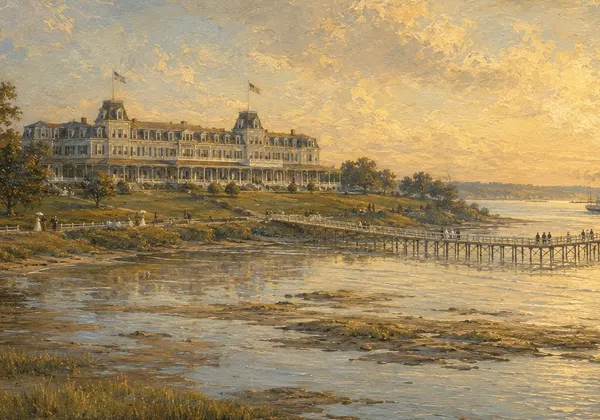
Lost Duxbury
A grand hotel, two vanished schools, twenty shipyards, and a real railroad, gone without much trace.
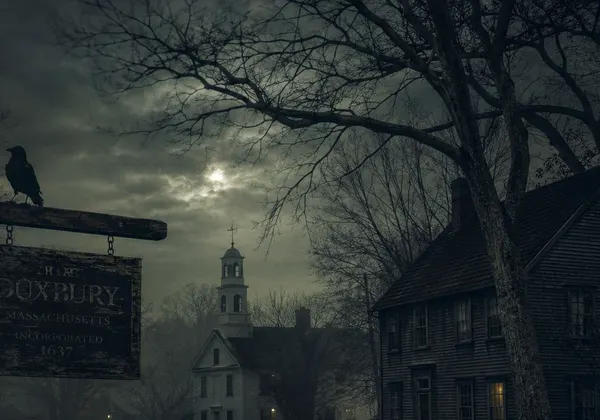
Folklore
The stories the record can't settle: a sea serpent, a tentacled gravestone, a grave opened three times.
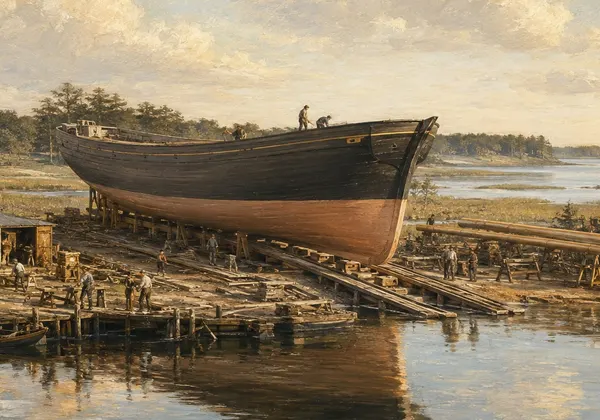
The living chart
Landmarks, legends, villages, walks, and the places that no longer exist, all pinned on one map.