
When Duxbury built ships.
Forest, timber, shipyard, launch, world: for about a hundred years, this shallow bay produced more sailing vessels than almost anywhere in New England, working entirely from wood cut within a mile of the water. What follows is a database, not a story with a moral. Every vessel below is drawn from the federal ship registers, and every one is real.
How do you launch a ship in a bay this shallow?
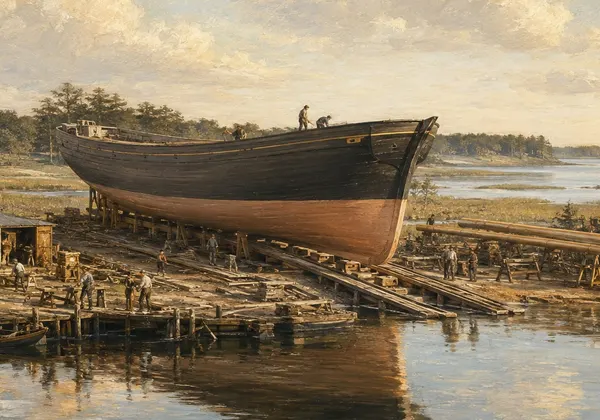
Duxbury Bay goes to mud at low water across most of its width. The yards solved this the way they solved most things, with patience and the tide: a launch was timed for an astronomical high, often months in advance, so the largest hull would float clear of the ways on the one day the water could carry it. When the 880-ton Hope went down the ways at the Ten Acre Yard on May 20, 1841, the yard picked a spring tide on purpose, and spectators lined both banks of the Bluefish River to watch a ship far too big for the river float anyway.
Four families, one industry
The Westons get the house and the nickname, and they earned both: Ezra Weston and Ezra Weston II built or acquired more than 110 vessels across three generations, and Lloyd's of London once ranked the son the largest shipowner in the country. But the register below tells a wider story. The Drews (Reuben, Charles, Silvanus, Sylvanus) built and owned dozens of vessels of their own. The Winsors named ships after each other. Levi Sampson's name recurs on some of the largest hulls in the district. Duxbury's shipbuilding age was a handful of families working the same half mile of riverbank, not one man's empire.
The database
| Year | Vessel | Rig | Tons | Owners | Master carpenter | Note |
|---|
Tap a column header to sort. LAST UPDATED: AUGUST 14, 2026
Sources & verification
The database draws entirely from Ship Registers of the District of Plymouth, Massachusetts, 1789–1908, compiled by the WPA's National Archives Project in 1939 from the original Plymouth Custom House documents, digitized by the Boston Public Library and held at the Internet Archive. Only vessels the register explicitly states were built at Duxbury are included here; this is a sample of 48, not the complete list of 268. Firm history and family detail drawn from the Duxbury Rural & Historical Society, Patrick Browne's King Caesar of Duxbury (DRHS, 2005), and Wikipedia's citations of the same. Know of a documented Duxbury-built vessel that belongs here? Tell us. Last verified: August 14, 2026.
Keep reading
King Caesar
Ezra Weston II, the ship Hope, and the fleet that briefly made a small town famous.
Lost Duxbury
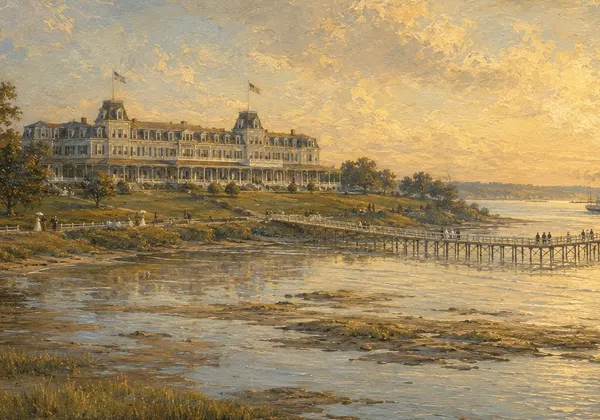
Twenty shipyards that left almost no trace, and the street their profits built instead.
The Uncommon 100
A growing, sourced list of the strangest true things about this town.