
Ninety years, nothing famous happens.
No war, no bridge, no shipbuilding fortune. Between King Philip's War and the Revolution, Duxbury just farms, argues about roads, and keeps a ledger. That ledger is more interesting than it sounds: a bounty paid for a wolf, a fine for cutting grass a day early, a lighthouse finally built on the Gurnet. This is the century History compresses into a single sentence, told in full.
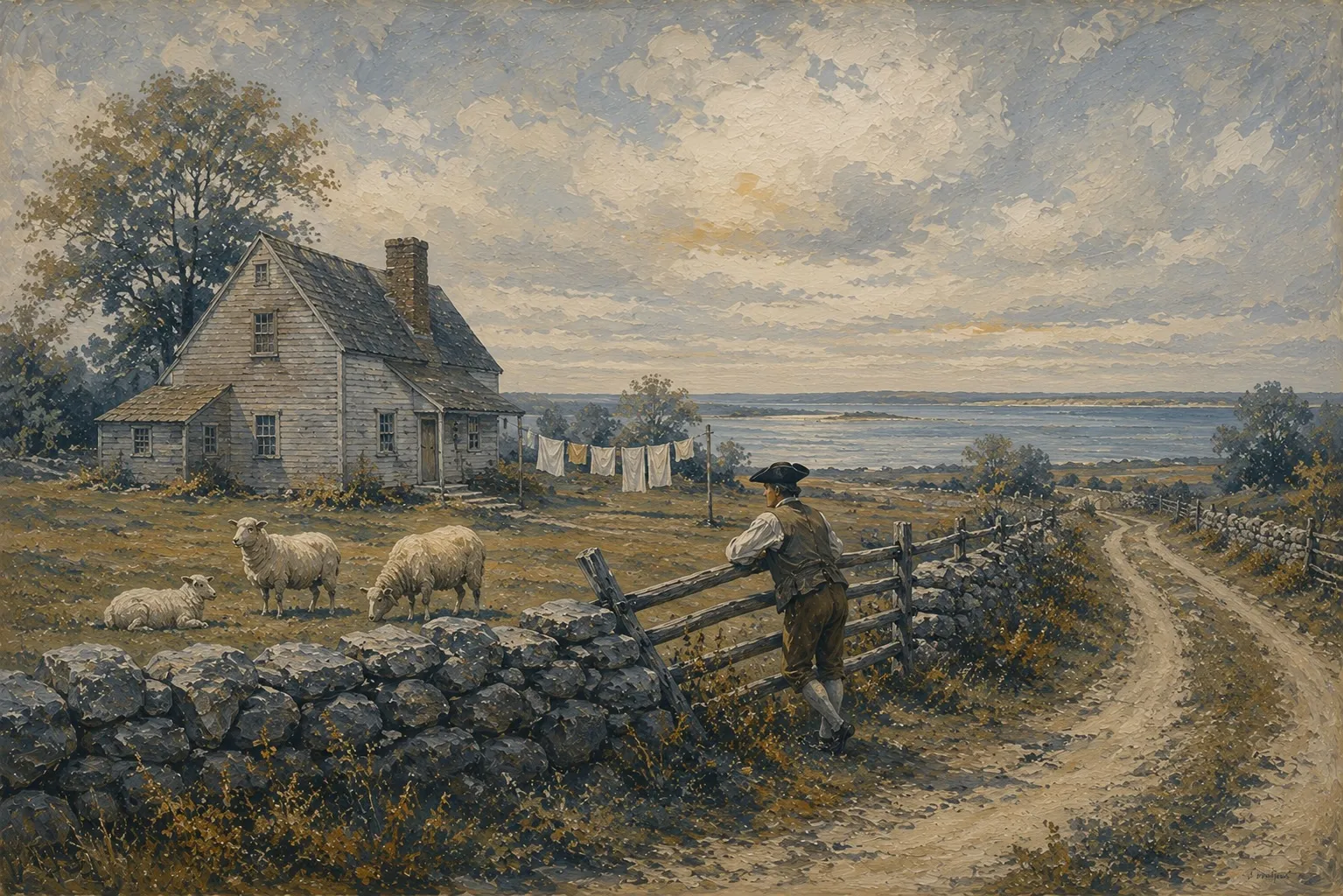 Ninety years of this, more or less · Duxbury Uncommon illustration
A colony becomes a province (1680s–1691)
Someone else's problem, finally
A new cart bridge goes up over the North River, a joint project with Scituate and Marshfield. In exchange, Duxbury is formally freed from ever again having to repair the Jones River bridge, the same structure that had been declared "dangerous for man and beast" back in 1650. One bridge headache traded for a shared one.
40 freemen
The count of men with full voting rights climbs to 40, up from 27 in 1646. The town that nearly un-founded itself fifty years earlier is still, slowly, growing.
An island changes hands
Clark's Island, used a generation earlier as a wartime detention site for Native people friendly to the English, is sold to three private owners: Samuel Lucas, Elkanah Watson, and George Morton. Full story on Mattakeesett.
Plymouth Colony stops existing
A new royal charter merges Plymouth Colony into the Province of Massachusetts Bay, ending 71 years as its own separate colony. Duxbury's own town government doesn't skip a meeting; it just starts answering to a different capital.
Ordinary life, kept in extraordinary detail (1690s–1710s)
Paid: 7 shillings, sixpence, for a wolf
The town's own account book records a payment "for a wolfe to an Indian," 7 shillings and sixpence: a real bounty, paid to a real person, for a real wolf. The same ledger shows Rodolphus Thacher paid ten shillings for sweeping the meetinghouse, and David Alden paid ten shillings simply "for wood."
Mending the pulpit door
The town pays Joseph Prior Jr. one shilling "for mending the pulpit dore" in 1676, and in 1692 pays Peter West 15 shillings sixpence for jury duty and "mending the meeting house." Nothing about running a colonial town was glamorous, and the records did not pretend otherwise.
Everyone gets a slice
The town votes to give every freeholder twenty acres of its common land, then spends five years sorting out exactly who qualifies. When the dust settles in 1712, 165 individual proprietors are named across just 56 family surnames, practically the entire town, divided by lot.
About 1,100 people
A count of 175 heads of families suggests a total population around 1,100, nearly three times what it had been at the start of the century.
Pembroke splits off
Pembroke is set off as its own town, the second real bite taken out of Duxbury's original, enormous footprint, following Bridgewater's departure in 1656.
Growing pains (1710s–1740s)
Wider roads for a bigger town
New roads are laid out from the Nook, 30 feet wide, and from "the point," 40 feet wide. Road widths, of all things, are a quiet proxy for how much more traffic the town now expects.
The cranberry factory
A new road is laid out from Asa Delano's land, "by the Cranberry factory," to the meetinghouse: proof that organized cranberry processing existed in Duxbury more than a century before it became a defining South Shore industry.
A bounty on birds, with one exception
Alarmed that "the wild fowle have almost forsaken the said bay," the town petitions to regulate hunting, and separately sets a bounty of three pence per crow-blackbird killed anywhere in town, except, specifically, "the salt house marsh or Beach." Nearly three centuries before piping plovers got legal protection, Duxbury was already treating its beach as a different kind of ground.
A highway over the sawmill dam
A new highway is laid out over the South River at the saw-mill dam, one more small piece of infrastructure connecting a town that keeps quietly filling in its own map.
Protecting the shore, and one big light (1740s–1770)
Keep the cattle off the beach
At a town meeting on May 20th, Duxbury votes to petition the General Court for an act "to prevent neat cattle going upon or feeding on Duxbury beach for the future," an early, direct ancestor of the dune and beach-grass protections your Beach guide still explains today.
The road to Powder Point, formalized
A road from the Captain's Nook to the Plymouth Road is accepted by the town in 1766. Two years later, Major Alden is allowed to put a gate on the road into Powder Point, so long as he lets a cart through his own farm to reach it, a very small, very human negotiation over a piece of land that would matter a great deal more a century later.
A light on the Gurnet
The Massachusetts legislature authorizes a lighthouse on the Gurnet: 30 feet long, 20 feet high, showing two lights from two lamps at each end. It will burn down in 1801 and be rebuilt in 1803, but for now, for the first time, ships approaching the bay at night have something to steer by.
Quiet, and about to end
Duxbury is, by its own later historian's account, "primarily a farming community," its 18th century undisturbed by much of anything. That is about to change. In the years just ahead, the town will turn out for the Revolution in numbers, showing little patience for Loyalists in its midst, and within a generation of the war's end will begin the shipbuilding boom that makes it briefly famous. Both are told in full on History.
Sources & verification
Drawn from Justin Winsor's "History of the Town of Duxbury, Massachusetts" (1849), Jeremy Dupertuis Bangs' published transcription of Duxbury's own colonial town records, the Duxbury Rural & Historical Society's local history summary, and the Plymouth County Observer's research into the beach's early preservation votes. Spot an error, or have a source we should see? Tell us. Last verified: August 5, 2026.
The Pilgrim Years
The sixty years before this one: land grants, incorporation, and King Philip's War.
Duxbury Beach Visitor Guide
Parking, stickers, dogs, plovers, and 270 years of the town deciding what the beach is for.
King Caesar
What happened right after this quiet century ended: the fleet that briefly made a small town famous.