
The oldest ground in the country, technically.
Duxbury's first meetinghouse went up in 1638, and the town started burying its dead beside it that same year. The ground outlasted the meetinghouse, went untended for a century, and was rediscovered by a town looking for its most famous resident. In 1976 a cemetery association gave it a title few places can claim: America's oldest maintained cemetery. Here's what's actually documented, and what isn't.
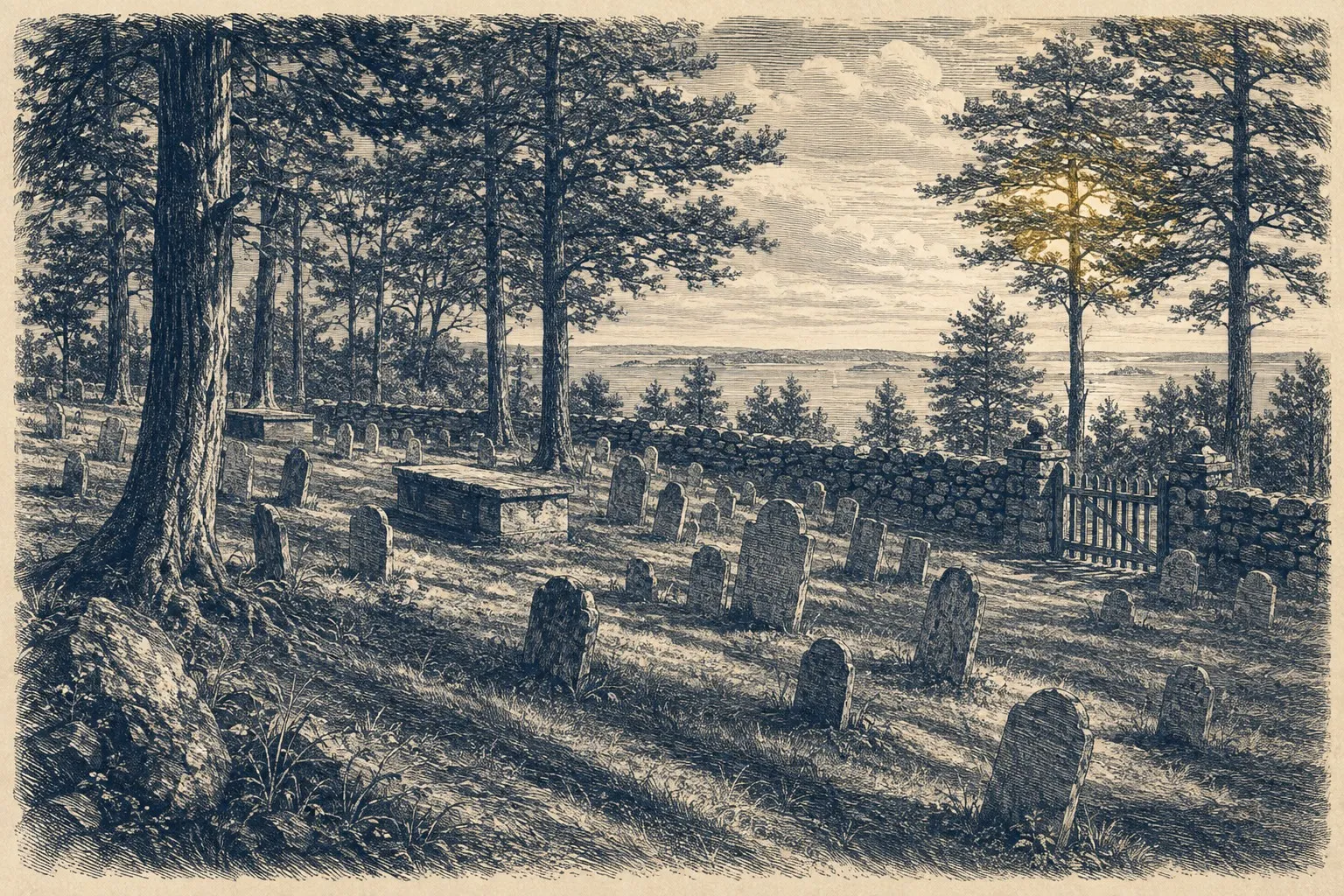 Since 1638, and still kept · Duxbury Uncommon illustration
Built beside the meetinghouse
Duxbury incorporated in 1637, and within a year the young town raised its first meetinghouse on a rise above the harbor and opened a burying ground beside it. The second meetinghouse is believed to have stood on the adjoining lot, land the Duxbury Rural & Historical Society still owns today. Among Plymouth Colony's own burying grounds, this one ranks second, after Plymouth's own Cole's Hill: a fitting rank for the colony's second town.
Who's actually here
Roughly 130 marked graves survive across the ground's acre and a half, though the true number of burials is almost certainly higher. Seventeenth-century Duxbury buried nearly everyone here, and the earliest markers were plain fieldstones or wood, long since sunk or gone. The oldest carved stone still standing belongs to Capt. Jonathan Alden, who died in 1697: the youngest son of Mayflower passengers John and Priscilla Alden. That stone has its own small odyssey. In the early 1800s a descendant found it broken and carried it home, where it sat for thirty years before it resurfaced in 1880; it took another Alden descendant searching the grounds to match it back to its original base, where it stands today. The second-oldest stone, from 1700, belongs to Rev. Ichabod Wiswall, buried under carved sea monsters, a story told in full on Folklore.
Standish, John and Priscilla Alden, and fellow Mayflower passenger George Soule are all believed to rest here, though not all with equal certainty. John Alden's approximate spot wasn't marked until 1930, and Priscilla's exact plot has never been found. For everyone else without a surviving stone, an exact grave is impossible to name.
The register
Roughly 130 stones stand here, and only 34 of them pre-date 1750. Most carry a name and two dates and nothing else the record can add. The dozen below are the ones with a documented story attached, in rough order of when they died. For everyone else, the stone survives and the story doesn't.
Myles Standish · c.1584–1656
The cemetery's namesake and its most argued-over resident. His actual grave was lost for two centuries before the town went looking for it; the exhumations and the feud that followed are their own story.
Sarah (Alden) Standish · 1627–1674
Daughter of John and Priscilla Alden, married into the Standish family. Part of the first generation of English children born in the colony to grow old here.
Priscilla (Mullins) Alden · death date unrecorded
Mayflower passenger, believed to rest beside her husband. No stone for her has ever been found, and no death date survives in the town's own record.
John Alden · d. 1687
The last surviving male passenger of the Mayflower's original 1620 crossing. His approximate resting spot wasn't marked until 1930, more than two centuries after he died.
Grace (Cole) Wadsworth · 1607–1688
An English-born immigrant to early Plymouth Colony, married to one of its early town officials. Genealogical record only; no surviving stone confirms the exact plot.
Capt. Jonathan Alden · 1633–1697
Son of John and Priscilla. His marker is the oldest surviving carved stone in the ground, and it has its own small odyssey, told above.
Rev. Ichabod Wiswall · d. 1700
Duxbury's second minister, and part of the three-man delegation that negotiated the 1691 charter merging Plymouth Colony into Massachusetts Bay, ending Plymouth's 71 years as an independent colony. His stone, carved with sea monsters, is the second-oldest here, a story told on Folklore.
Eliphas Weston · d. 1762
Died with his son Joshua in the same snowstorm. One stone marks both losses.
George Partridge · 1690–1768
Not the congressman the town later named a school after: his father, and a Duxbury town official in his own right.
Hannah (Foster) Partridge · 1694–1778
Outlived three husbands, a fact her own stone records.
Ezra Arnold · 1707–1780
The last dated stone standing in the ground. Nine years after he was buried, Duxbury stopped using this cemetery for good.
A century of quiet
Burials here trail off by about 1789. What follows is neglect, not memory. Fieldstones toppled, inscriptions wore past reading, and the ground gave way to overgrowth and grazing cattle over the graves of the town's founders, a quiet decline that runs alongside the same shipbuilding-bust years told on the History timeline.
Found, and fought over
In 1883, residents alarmed at the fading town founded the Duxbury Rural Society, today the Duxbury Rural & Historical Society, to improve and ornament what the bust had left behind. In 1887 they turned to this ground specifically, clearing brush and resetting stones. What happened next is documented in unusual detail: the search for Standish's actual grave, two exhumations, and the rival historical society the dig produced. That story is told in full in Duxbury after dark. It ends, for now, with a monument ringed by cannons the Navy gave the town in the mid-1950s.
Still the oldest, probably
The ground joined the National Register of Historic Places in 2015 and is maintained today by the Town of Duxbury. In 1976 the American Cemetery Association declared it the oldest maintained burying ground in the country, and the plaque announcing it went up the following year. It's a title worth exactly as much as the organization behind it: enough to bring visitors, and no more than that.
Sources & verification
Drawn from the Town of Duxbury's Old Burying Ground page, the Duxbury Rural & Historical Society's published history and photograph archive, the National Register of Historic Places listing (2015), Historical Digression's account of the site's rediscovery, and, for the register above, Vital Records of Duxbury, Massachusetts, to the Year 1850 (New England Historic Genealogical Society), Old Cemeteries of Southeastern Massachusetts by Charles M. Thatcher, and cross-checked genealogical compilations. Individual burial dates carry the same uncertainty as everything else in a ground this old: where the record is thin, we've said so rather than guessed. Spot an error? Tell us. Last verified: August 14, 2026.
The courtship, fact-checked
Longfellow made Duxbury's founders famous. What the record shows about Standish, Alden, and Priscilla.
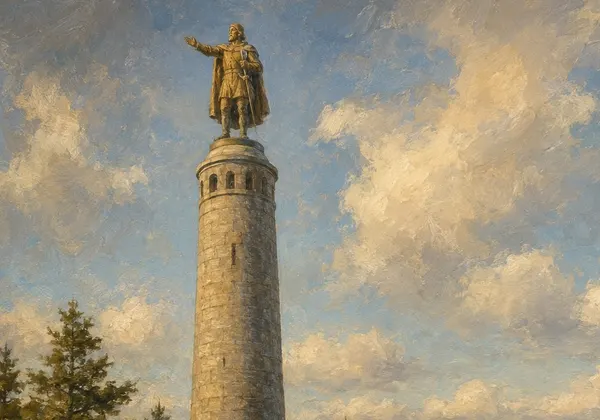
Myles Standish, the actual soldier
The hired sword of Plymouth Colony, the Wessagusset killings, and the farmer of the Nook.
Duxbury after dark
The grave dug up three times, the feud it caused, and the rest of the town's legends, actually told.