
Wrecks & rescues.
Six miles of barrier beach face the open bay, and for centuries that beach was the last thing some vessels ever met. This is the documented record of the wrecks and rescues of Duxbury Beach and the Gurnet: the ships, the storms, the lighthouse keepers, and the surfmen who walked the sand at night looking for trouble. Every entry carries a source. Where the record is folklore, we say so.
The General Arnold, 1778
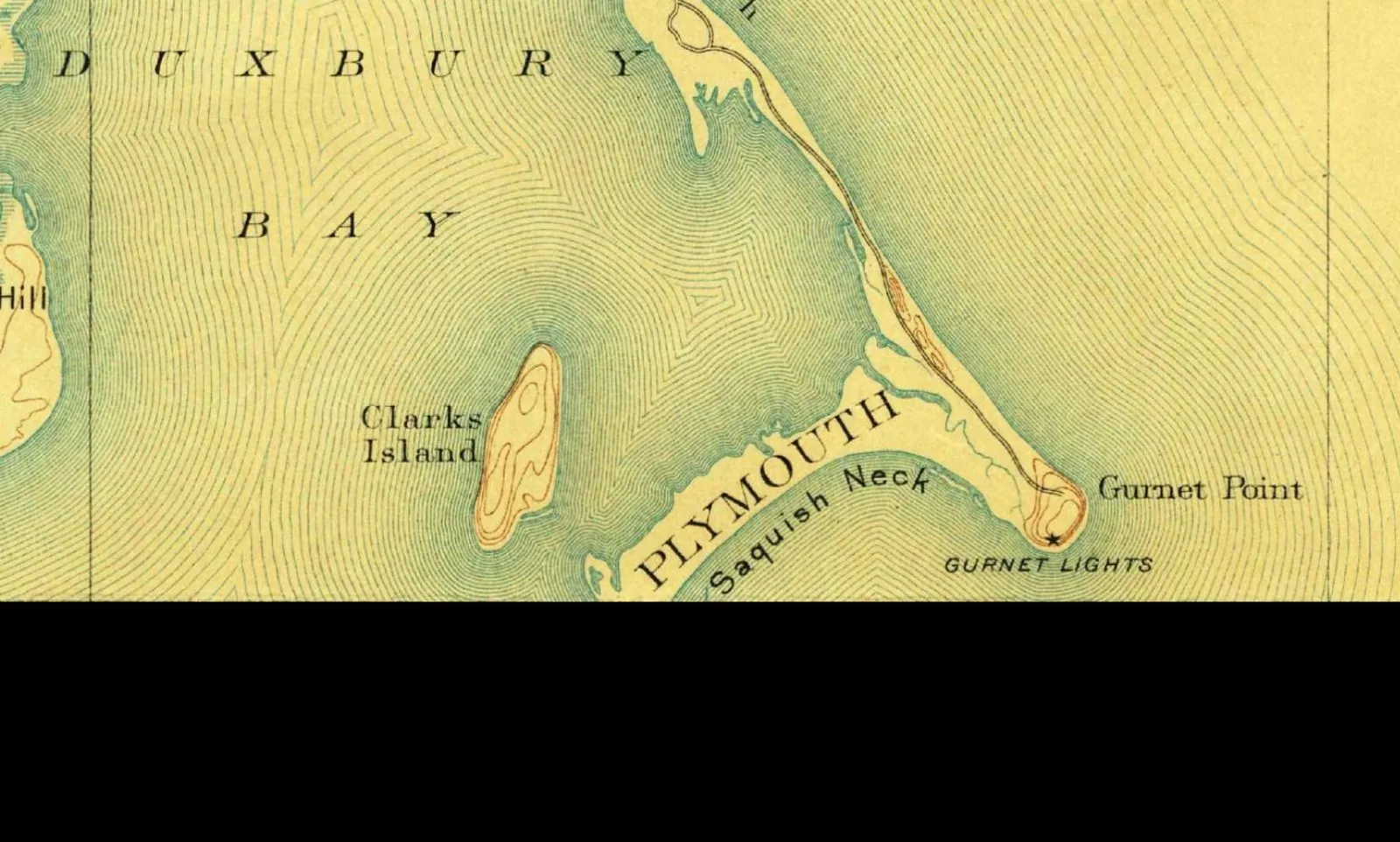
On Christmas Eve 1778 the privateer brigantine General Arnold left Boston for the West Indies with twenty guns and about 105 men under Captain James Magee. A blizzard caught her almost immediately. Magee ran for Plymouth Bay and anchored under the Gurnet, within sight of the light, waiting for a pilot who could not come out. Through the night the storm grew, the anchor dragged, and near dawn on December 26 she went aground on White Flat inside the bay. Her seams opened, the hold flooded, and the crew was driven to the open deck in sub-zero cold. Plymouth could hear the men but could not reach them; boats turned back in the ice. When rescuers finally crossed on December 28, over a causeway of ice chunks, roughly seventy of the company were dead or dying of exposure. Most lie in a mass grave on Burial Hill in Plymouth, under a monument raised to their memory. It remains the worst maritime disaster ever to happen inside these bays, and it began at anchor off the Gurnet, a light plainly burning less than a mile away.
The lights, the fort, and Hannah Thomas
The Gurnet got its lighthouse in September 1768: a wooden keeper's dwelling with a lantern at each end of the roof, America's first twin lights, built on the farm of John and Hannah Thomas for a ground rent of five shillings. John, the first keeper, joined the Continental Army, raised a Plymouth County regiment, rose to major general, and died of smallpox in Quebec in June 1776. Hannah kept the lights, and with that became the first woman lighthouse keeper in America, serving from 1776 to 1786 while raising three children and running the farm. During the war, Plymouth, Duxbury, and Kingston together built Fort Andrew beside the lights, and in 1776 the British frigate Niger traded fire with its battery; local tradition holds that one of the frigate's cannonballs passed through the lighthouse itself. The original building burned in 1801 and was rebuilt as twin towers, which shone in pairs until 1924. The single tower standing today is the oldest freestanding wooden lighthouse in the United States. Its beam has failed the coast exactly when needed at least once: on the snow-choked night of March 9, 1928, the shrouded Gurnet lights could not warn the steamer Robert E. Lee off the Mary Ann Rocks near Manomet. All 273 passengers were taken off safely the next day, but three of the Coast Guard rescuers from Manomet Point drowned when their surfboat pitchpoled coming home.
The surfmen of the Gurnet
Two years after the Life-Saving Service was reborn in 1871, it began building a pair of stations to guard the approaches to Plymouth Bay. The Gurnet station went up in 1874 at the end of the peninsula, sharing the point with the lighthouse, with its district running north along the outside of Duxbury Beach. A larger station replaced the original boathouse in 1892, and the old building stayed on as an auxiliary. The surfmen's work was mostly walking: beach patrols through the night, in every weather, watching for a hull in the surf. When the pull came they answered it, as the record below shows. The station building survives on the Gurnet today as a private summer residence, listed in the National Park Service's inventory of historic life-saving stations.
The Portland Gale, 1898
The storm of November 26 and 27, 1898 was the worst New England's coast had ever recorded: hurricane-force wind for a day and a half, more than 400 dead, at least 140 major vessels wrecked or sunk. It takes its name from the steamer Portland, lost off Cape Cod with everyone aboard, about 191 people; recovered watches had stopped at 9:15. In Duxbury the gale damaged the pier, tore at the beach, and wrecked dozens of ships and small craft along the shore. Just up the coast at Marshfield the fishing schooner Mertis H. Perry was thrown onto the beach with five of her fourteen men lost. And in the days after, the Gurnet life-saving crew walked their patrols past the Powder Point Bridge recovering the storm's dead from the outside beach, among them a man in oilskins marked "Haley," believed to be one of four missing Norwell fishermen. The same storm cut the new mouth of the North River at Scituate. This coast was not the same afterward, and neither was the beach.
The record, so far
Documented wrecks, rescues, and losses of Duxbury Beach, the Gurnet, and the approaches · sources for every entry
| Date | Vessel / event | What happened | Source |
|---|---|---|---|
| Dec 26, 1778 | General Arnold privateer brigantine, 20 guns |
Anchored off the Gurnet in a blizzard, dragged, and grounded on White Flat. Roughly 70 of about 105 aboard froze or drowned before rescuers crossed the ice on Dec 28. Mass grave and monument on Burial Hill, Plymouth. | Contemporary accounts via Snow, Tales of Terror and Tragedy; Plymouth histories; Burial Hill monument |
| 1776 | HMS Niger vs. Fort Andrew | British frigate exchanged fire with the six-gun battery Plymouth, Duxbury, and Kingston had built beside the Gurnet lights. Tradition holds a cannonball struck the lighthouse. Not a wreck, but the beach's one naval engagement. | New England lighthouse histories; Project Gurnet & Bug Lights |
| Nov 26–27, 1898 | The Portland Gale | Dozens of ships and boats wrecked on Duxbury's beaches; the pier damaged; the beach badly eroded. Gurnet surfmen recovered victims of the storm on the outside beach near the Powder Point Bridge. | Contemporary press, Dec 1898; storm histories |
| Nov 1907 | Lucy E schooner |
Wrecked near Duxbury in the November gale. Her crew was saved by the Gurnet Life-Saving Station. | Monthly Weather Review, vol. 35, Nov 1907 |
| Mar 9–10, 1928 | Robert E. Lee steamer, 400 ft |
Aground on the Mary Ann Rocks off Manomet after snow hid the Gurnet lights. All 273 passengers saved; Coast Guardsmen Cashman, Griswold, and Stark of Manomet Point died when their surfboat overturned returning ashore. | U.S. Life-Saving Service Heritage Assn. (Galluzzo, Wreck & Rescue); USCG history |
The station's ledger, 1877–1909
The Life-Saving Service published an annual report every year of its existence, and buried in each one is the working record of every station: each vessel boarded, warned, pumped out, hove off, or lost. We went through the sixteen volumes digitized on the Internet Archive, fiscal years 1876 through 1909, and pulled every entry credited to the Gurnet station. Read together they are less a catalog of disasters than a portrait of a job: the same shoal, Brown's Island, catching schooner after schooner at the harbor mouth; a keeper warning a vessel off Bass Rock by waving his sou'wester from the bluff; a lone surfman, the rest of the crew away at drill, rowing out alone to pilot a Bangor schooner clear. The keeper for much of this era was Captain John F. Holmes, whose station file holds thank-you letters from a yachtsman with a broken arm, a grateful Mrs. Frame, and the master of the Daniel Boone, who wrote to the Boston Journal after the crew hand-carried four-hundred-pound pieces of iron ballast out of his flooded hold. One of Holmes's surfmen, E. J. Tobin, invented rescue gear at the station and sent it to the Service's national equipment board for review. And in 1909 the ledger records a schooner named Tecumseh, forty-one tons, hailing from Duxbury itself, aground on the same Brown's Island Shoal her neighbors knew by heart.
Every Gurnet station entry found in the digitized annual reports · dates converted from the reports' July–June fiscal years
| Date | Vessel | What happened | Report |
|---|---|---|---|
| Oct 7–8, 1877 | Teaser sloop, Swampscott | Disabled passing Gurnet Point, anchored in Saquish Cove. Station crew repaired her and piloted her out beyond the point. | FY1878 |
| Oct 5, 1881 | Winnie Lawry schooner, Waldoboro, Me. | Driven to leeward in a northerly gale with a cargo of molding sand, ashore on Brown's Island Shoals in Duxbury Bay. | FY1882 |
| Oct 18, 1881 | Forest Queen schooner, Boston | Grounded on Brown's Island Shoals running into Plymouth Harbor for shelter; crew went out with hawser and kedge. | FY1882 |
| Dec 19, 1881 | Milton schooner, Bangor, Me. | Standing into danger inside Brown's Island Shoals; the one surfman left at the station rowed out alone and piloted her clear. | FY1882 |
| Jan 30, 1882 | Arcilla British schooner, Saint John | Anchored exposed south-southeast of the station; crew boarded her, got her under way, and piloted her clear. | FY1882 |
| Feb 22, 1882 | Robert Ripley schooner, Camden, Me. | Broke her moorings in Duxbury Bay in a northeast gale and snowstorm, days after delivering a cargo at Duxbury, and drove ashore on Long Beach. | FY1882 |
| Mar 17, 1882 | Hudson British schooner, molasses from Porto Rico | Anchored dangerously near Brown's Island Shoals in a northeast gale; the surfboat reached her through a long line of breakers. | FY1882 |
| Jul 21, 1883 | Julia sailboat | A Plymouth excursion party grounded at the point on a falling tide. The keeper, alone at the station for the summer, floated them off and saw them home. | FY1884 |
| Sep 2, 1883 | Milo schooner, Saint John, N.B. | Ashore on Brown's Bank and full of water; a wreck. The station crew stripped and saved her sails and rigging. | FY1884 |
| Sep 27, 1883 | Osseo schooner, Saint John, N.B. | Fouled getting under way after loading the salvage of the Milo off Gurnet Point; assisted. | FY1884 |
| Oct 23, 1883 | William V. Hutchins schooner, Gloucester, 14 crew | Swept onto Brown's Bank off Long Beach by the ebb tide leaving Plymouth on a fishing cruise. | FY1884 |
| Dec 24, 1883 | Avon schooner, Windsor, N.S. | Nearly ran onto Bass Rock in thick weather. The lighthouse keeper spotted her from the tower; the station keeper ran to the bluff and warned her off by shouting and waving his sou'wester. | FY1884 |
| Mar 5, 1884 | Unnamed schooner | Waiting for a pilot in a night snowstorm, twice stood in nearly onto Gurnet Point; warned off first by Coston signal, then by the keeper's voice at close hail. | FY1884 |
| Mar 31, 1884 | Fanny and Edith schooner, Belfast, Me. | Anchored in a dangerous berth near Brown's Bank with a cargo of lime and a master whose fingers had frozen; boarded and carried to safe anchorage. | FY1884 |
| Sep 13, 1887 | Oresa (dory) schooner, Gloucester | Her dory found adrift off the station, recovered, and returned to the schooner. | FY1888 |
| Dec 17–18, 1887 | Myrtle U.S. lighthouse tender | The Light-House Service's own steamer grounded on Brown's Bank at extreme low tide, seven-eighths of a mile south of the station; attended. | FY1888 |
| Jul 11, 1888 | Pawtuxet steam launch, Boston | Out of boiler water and barely steering off the station; assisted, the keeper hiring two hands with the station closed for summer. | FY1889 |
| Aug 28, 1888 | Phil Sheridan catboat | Assistance rendered; those aboard were succored with relief supplies at the station. | FY1889 |
| Mar 11, 1892 | Cyrus Chamberlain schooner, Thomaston, Me. | Assistance rendered about two miles west by south of the station. | FY1892 |
| Aug 23, 1895 | Daniel Boone fishing schooner | Grounded on a quicksand bar two miles from the station and filled at high water. The crew hand-carried her iron ballast out of the flooded hold, pieces of it weighing 400 pounds, and floated her. Her master thanked Captain Holmes in the Boston Journal. | FY1896 |
| May 3, 1896 | Ellen B. catboat | A man rescued at the station. | FY1896 |
| Sep 1897 | Adele sloop yacht | A mishap off the station that broke her owner's arm; his letter of thanks to Keeper John F. Holmes is printed in the annual report. | FY1898 |
| May 20, 1898 | W. O. Nettleton schooner, Nantucket | Assistance rendered. | FY1898 |
| Dec 30, 1908 | Hastings schooner, 84 tons, Rockland, Me. | Attended on Brown's Island Shoal. | FY1909 |
| Jan 26, 1909 | Helvetia schooner, 141 tons | Attended off the station. | FY1909 |
| 1908–09 | Rose Standish schooner, 45 tons, Plymouth | Attended on Brown's Island Shoal, carrying the name of Myles Standish's first wife. | FY1909 |
| 1908–09 | Elva L. Spurling schooner, 74 tons, Boston | Attended on Brown's Island Shoal. | FY1909 |
| 1908–09 | Tecumseh schooner, 41 tons, Duxbury | A Duxbury vessel, aground on Brown's Island Shoal at her own harbor's mouth. | FY1909 |
| 1908–09 | Emma F. Angell schooner, 362 tons, Fall River | Attended a mile and a quarter east of the station. | FY1909 |
| Spring 1909 | Eleazor Boyton schooner, 88 tons, Boston | Attended five miles west of the station. | FY1909 |
| Spring 1909 | Alice schooner, 67 tons, Boston | Attended a quarter mile south of the station. | FY1909 |
Alongside the vessels, the ledger keeps a steady account of smaller kindnesses: dories chased down in the ice and hauled above the tide line for their owners, a sailor whose boat came to grief given his dinner at the station and walked home, an excursion party floated off the rocks by a keeper minding the point alone all summer. That was the job too.
Help the record grow
This is a living record, and it is short on purpose: nothing goes in the table without a source we can point to. The sixteen digitized annual reports have now been mined above, but the volumes for several years, including fiscal 1899, the year of the Portland Gale, are not yet online, and the Drew Archival Library on St. George Street holds letters and logs this page hasn't touched. If your family kept a story, a clipping, or a photograph of a vessel ashore on the beach, send it through the tip line. Wrecks with names get remembered; wrecks without them wash away twice.
Sources and method
Entries are drawn from the annual reports of the U.S. Life-Saving Service (sixteen digitized volumes, fiscal 1876 through 1909, read in full-text via the Internet Archive), contemporary press accounts, the Monthly Weather Review, U.S. Coast Guard and Life-Saving Service histories, lighthouse service records, and the published histories of Plymouth and Duxbury. Ledger dates are converted from the Service's July-to-June fiscal years; a few table scans are too garbled to yield a vessel's name with confidence, and those entries wait rather than guess. Where an account is tradition rather than record, such as the Niger's cannonball, it is labeled that way. The Gurnet and White Flat lie in Plymouth waters by the map, but the beach that leads to them is Duxbury's, the fort was partly Duxbury's work, and the surfmen walked Duxbury sand; the record follows the geography rather than the town line. The header image is the 1893 federal survey of the approaches, from the same public-domain sheets as our then & now viewer.
Folklore
The legends of the town, told straight, with the history that grew them.
Then & now
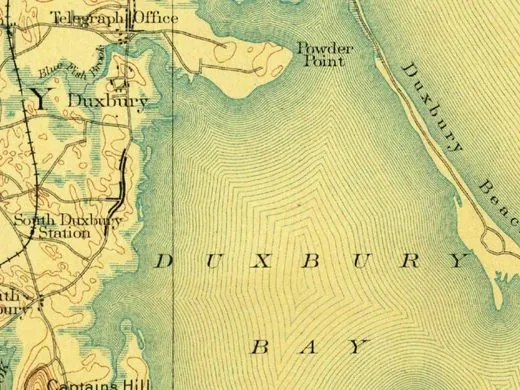
Eight survey maps of the town, laid over each other on one slider.
The Powder Point Bridge
A history of the Long Bridge, from a draw for tall vessels to the current battle over concrete.