
Twenty-five years, and only two Loyalists.
The quiet century ends the way a lot of quiet things end: suddenly. A farming town that had spent ninety years arguing about roads and bird bounties turned out, almost to a man, against the Crown. This is the record of how that happened, who the two exceptions were, and how a Duxbury private who enlisted at thirteen grew up to captain ships on the open Atlantic, which is roughly where the next chapter of History picks up.
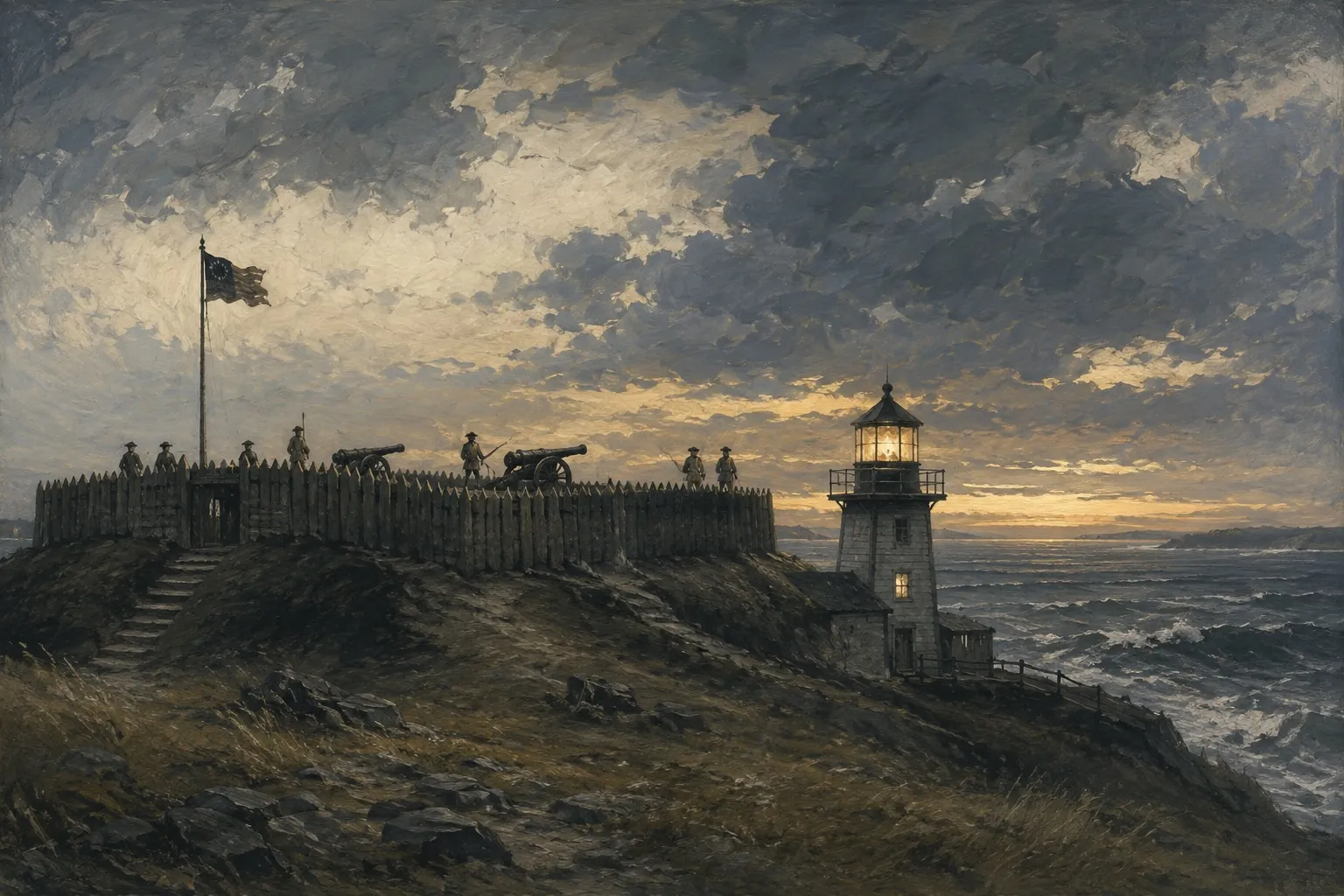 The fort and the light, the Gurnet · Duxbury Uncommon illustration
Taxes and effigies (1765–1774)
Crowds on Captain's Hill
News of the Stamp Act reaches Duxbury, and residents gather on Captain's Hill, the same ground Myles Standish once farmed, to burn effigies of British officials. The hill that made the town's name a century earlier now hosts its first open act of rebellion.
A quiet exception, next door
General Gage, responding to pleas from Loyalists in neighboring Marshfield, stations a company of British regulars there. Duxbury, sharing a border and a militia tradition with the town, takes notice.
Two Tories, by one man's count
According to the memoirs of Seth Sprague, a Duxbury resident who lived through it, the town was so fiercely Whig that only two Loyalists could be found in the whole place: Gamaliel Bradford Sr. and Briggs Alden, father of the later militia officer Judah Alden. Both would not stay Loyalists for long.
War arrives (April 1775)
News from Lexington
Word of the fighting at Lexington and Concord reaches Plymouth County within hours. Colonial militia companies that had been drilling for months rapidly gather.
A near-battle in Marshfield
Under Colonel Theophilus Cotton, a colonial regiment of volunteers from Plymouth, Kingston, and Duxbury marches on Marshfield to confront the British company stationed there. The council of war is held at the Duxbury home of Lt. Col. Briggs Alden, one of the town's two named Loyalists just weeks earlier. The Americans outnumber the British six to one; Cotton hesitates to attack. By 3 p.m., British sloops arrive off Brant Rock and carry the regulars back to Boston, unharmed.
Both Tories recant
In the immediate aftermath of Lexington and Concord, both Gamaliel Bradford Sr. and Briggs Alden publicly recant their Loyalist sympathies. Bradford's own son, also named Gamaliel, will go on to command one of the war's most storied Duxbury regiments.
Ten companies, one regiment (1775–1780)
Duxbury's largest company marches
Captain Samuel Bradford's company, nearly 100 men, is stationed first in Plymouth and then sent to Roxbury as part of the newly forming Continental Army, taking part in the siege of Boston.
A fort on the Gurnet
A substantial fort is built at the Gurnet, manned mostly by Duxbury men. Two Duxbury companies serve six-month terms there across 1776 and 1777. They see no action, which for the men standing watch over an empty horizon was presumably a fine outcome.
Valley Forge, Germantown, Monmouth
Two Duxbury companies, under Captains Joseph Wadsworth and Thomas Turner, join the 14th Massachusetts Regiment, commanded by the town's own Colonel Gamaliel Bradford, the recanted Tory's son. Turner's Company serves longer than any other Duxbury unit, from 1777 to 1780, enduring the hard winter at Valley Forge and fighting at Germantown and Monmouth.
A private, age thirteen
Colonel Bradford's own son, also Gamaliel, enlists in his father's regiment as a private at around thirteen years old. He survives the war, goes to sea afterward, and by the 1790s commands merchant ships; in 1799 and 1800 he fights off French privateers in two separate engagements off Gibraltar and Cadiz.
270 men, on record
Roughly 270 Duxbury men served the revolutionary cause at some point during the war, by later research, representing the vast majority of the town's adult male population. Ten separate companies were organized in Duxbury between 1775 and 1778 alone, some lasting only as long as a single alarm, others serving for years.
After the war (1780s–1790s)
The Treaty of Paris
The war ends, and the new nation is granted fishing rights on the Grand Banks, access that had been closed to the colonies under British rule.
The turn to the sea
With Grand Banks fishing open and a peacetime economy to rebuild, Duxbury pivots hard toward shipbuilding, beginning what its own historians call the most remarkable period in the town's history. The full story, and the man who would come to dominate it, is on King Caesar.
From farm to fleet
The private who enlisted at thirteen is, by now, a master mariner routing enemy privateers on the open Atlantic. The fierce, nearly unanimous rebellion of a small farming town has produced, within one generation, the seafaring confidence that will shortly make it one of the largest shipowning towns in the country.
Sources & verification
Drawn from the Duxbury Rural & Historical Society's own account of Duxbury in the Revolution, the memoirs of Seth Sprague (1760–1847) as preserved in later genealogical compilations, and public genealogical and military records for Colonel Gamaliel Bradford and his son. The Marshfield confrontation and the Gurnet fort are corroborated across multiple independent sources. Spot an error, or have a source we should see? Tell us. Last verified: August 5, 2026.
The Quiet Century
The ninety years before this one: a wolf bounty, a lighthouse, and not much else.
King Caesar
What happened right after this war ended: the fleet that briefly made a small town famous.
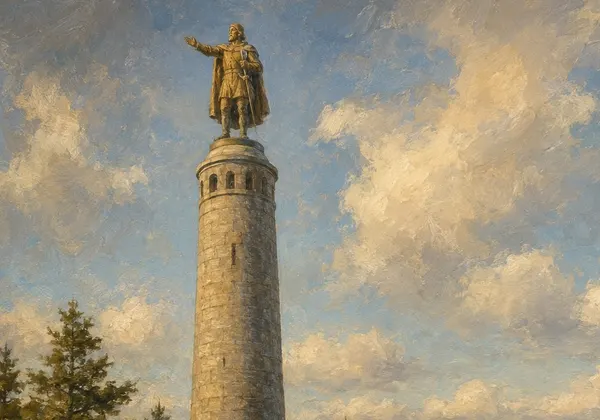
The Myles Standish Monument
The hill where residents burned effigies in 1765 now holds a 116-foot tower to the town's most famous soldier.