
Standish and Alden didn't build this alone.
Two names carry almost the entire colonial story on this site, and on most others: Standish and Alden. The actual town, the roads, the mills, the juries, the land divisions, was built by dozens of families whose names now mostly survive as street signs, if they survive at all. Here are a few of them, including one man whose descendants outnumber every Mayflower name on this page combined.
Philip Delano (the ancestor of a president nobody expects)
Born Philippe de Lannoy in Leiden, Holland, around 1602, to Walloon refugees who had fled religious persecution in what's now northern France. He crossed on the Fortune, the second Pilgrim ship, arriving at Plymouth in November 1621 as an eighteen-year-old traveling alone, joining his uncle Francis Cooke, who'd come over on the Mayflower the year before. He took a land grant in Plymouth in 1623, sold it in 1627, and moved to Duxbury, where he became a freeman in 1633 and, per the town's own road records, one of four men on the 1637 jury that laid out Duxbury's first formal highway.
His name anglicized from de Lannoy to Delano, and his descendants became one of the largest families in town: eleven separate Delano proprietors are named in the 1710 division of Duxbury's common land, more than almost any other surname. They also became, a few centuries on, considerably more famous than that land division could have predicted. Philip Delano is a direct ancestor of Franklin Delano Roosevelt, and, through other branches, of Ulysses S. Grant, Calvin Coolidge, and Laura Ingalls Wilder. The 32nd president's middle name is, quite literally, a Duxbury founder's surname.
George Soule and the second-oldest stone
A Mayflower passenger who crossed as a young manservant rather than a free settler, Soule went on to become a Duxbury landowner, a juror on multiple town committees, and the ancestor of a family numerous enough that a set of ledges off Powder Point still carry his son Zachary's name: Zachary's Rocks. Soule is buried in the Old Burying Ground alongside Standish and the Aldens, one of the small handful of Mayflower passengers whose resting place in Duxbury is documented at all.
William Collier and Experience Mitchell
Collier was among the very first men to take land in Duxbury alongside Standish, Alden, and Brewster, one of a handful of settlers named in the earliest colony records as farming the new ground while still officially resident in Plymouth. Winsor's own history, writing from Captain's Hill in 1849, singles him out for having "strove with unceasing toil" in service of the colony's welfare through every circumstance of danger, a very nineteenth-century way of saying the man showed up and did the work. Experience Mitchell arrived on the same ship as Philip Delano, the Fortune, in 1621, and by 1640 was serving as one of Duxbury's first official highway surveyors, the year the town's bounds were fixed for good.
Constant Southworth (the governor's stepson)
Southworth's mother, Alice, was a widow when she married Governor William Bradford in 1623, which made Constant the Governor's stepson and gave Duxbury a direct family line into Plymouth's top office. He served as a surveyor of highways as early as 1640 and, nine years later, was one of three men, alongside Myles Standish and Samuel Nash, who purchased the fourteen-mile-square Satucket tract from the Wampanoag sachem Massasoit on behalf of "all the townsmen of Duxbury," land that would later become the separate town of Bridgewater. Full story on The Pilgrim Years.
The Barkers (the family that vanished)
By 1710, when the town divided its common land among freeholders, the Barker family claimed more shares than any other surname in Duxbury: eleven individual Barkers, from Robert Sr. down through a run of sons and grandsons. They were, by that measure, the single largest family in town. Justin Winsor, writing his history less than a century and a half later, noted with something close to surprise that "of the Barker family, which was then... one of the most numerous in the town, there is now scarcely a representative." A family that once outnumbered the Aldens on every town ledger had, within a few generations, all but disappeared from local memory. It's a useful reminder that "founding family" is not the same thing as "permanent family," and that most of the people who actually built this town left no monument at all.
Sources & verification
Drawn from Justin Winsor's "History of the Town of Duxbury, Massachusetts" (1849), public genealogical records for the Delano and Soule families, and Wikipedia's sourced entry on the Delano family's presidential and literary descendants. The Barker family's 1710 share count and its near-disappearance by 1849 are both quoted from Winsor's own account. Spot an error, or know a founder we left out? Tell us. Last verified: August 6, 2026.
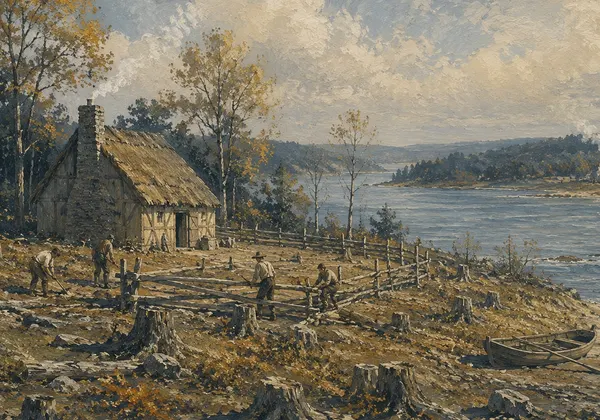
The Pilgrim Years
Land grants, incorporation, and the 1649 purchase Constant Southworth helped negotiate.
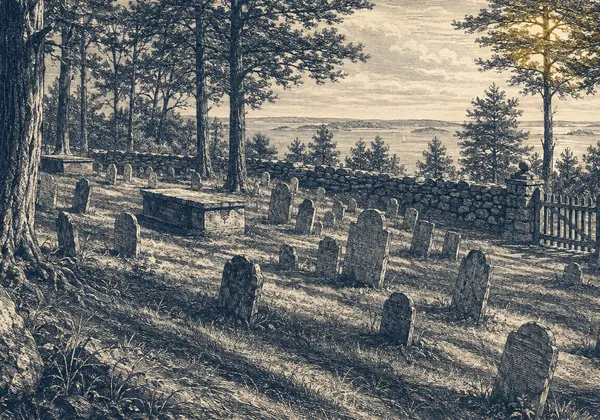
The Old Burying Ground
Where George Soule rests alongside Standish and the Aldens.
Village Names
Sodom, Ashdod, and the neighborhoods these same families once lived in.