
So you're moving to Duxbury.
Welcome. What follows is the orientation nobody sends you: what the villages mean, which stickers to get in week one, and the rules that never make it into a listing.
Get oriented
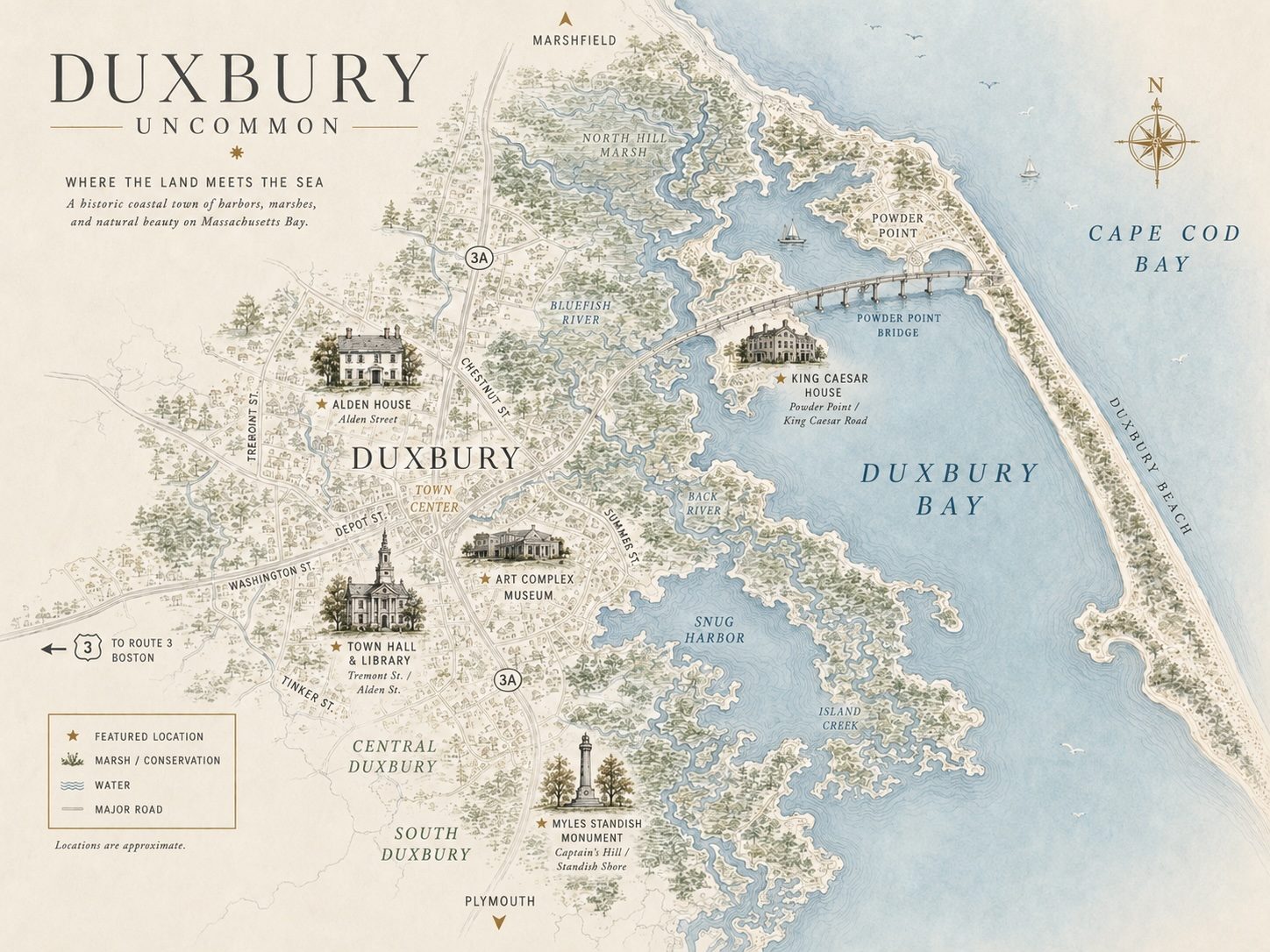
The map above is worth pinning to the fridge. It shows the lay of the town: the bay, the barrier beach, the villages, and the handful of roads that tie them together. Snug Harbor, Powder Point, and the beach all come up again and again in this guide, so it helps to know where they sit before the names start flying.
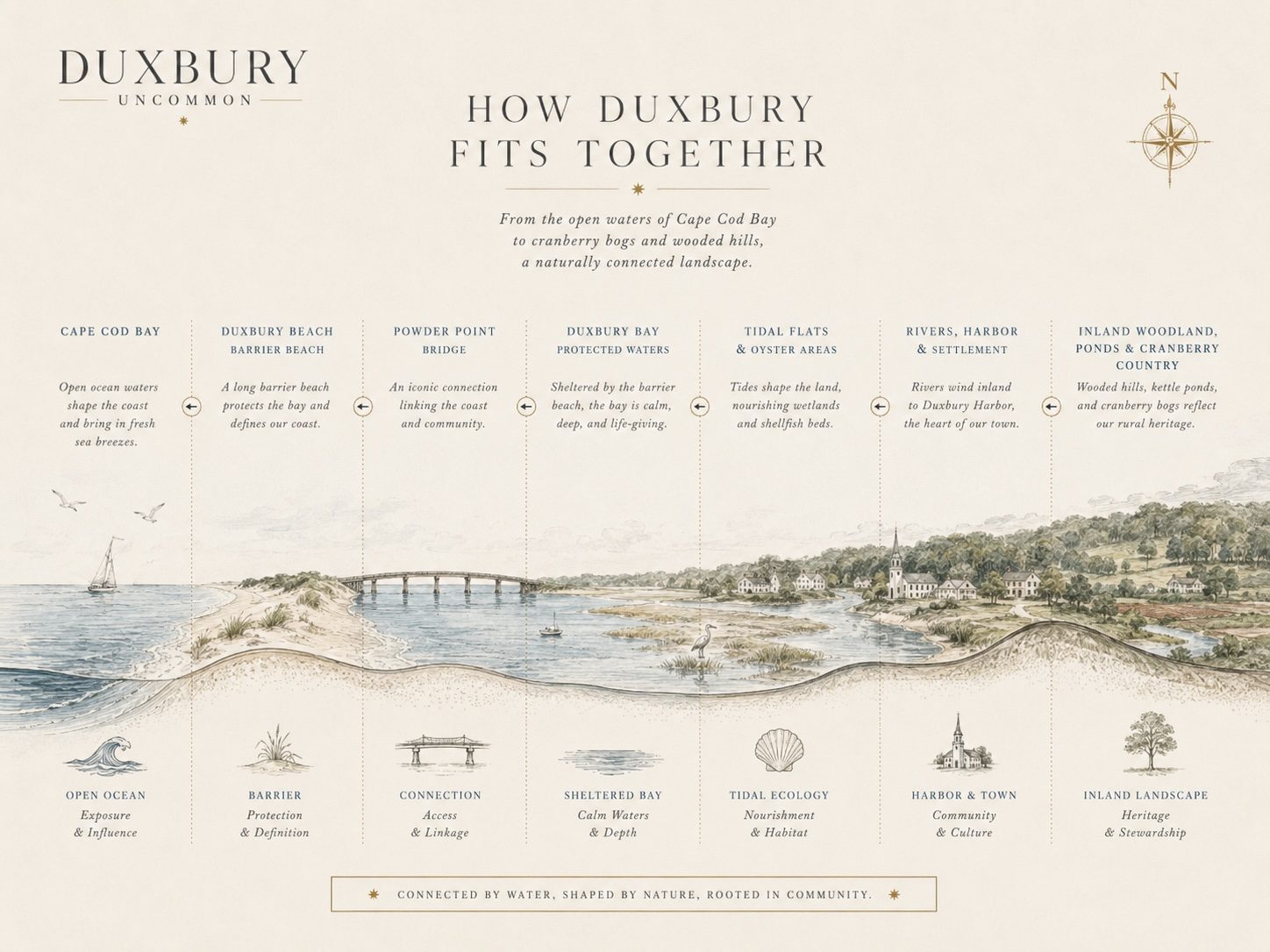
Now turn the map on its side. Read as a cross-section, Duxbury is a sequence of layers: Cape Cod Bay, the barrier beach, the wooden bridge, the sheltered bay and its tidal flats, the harbor town, and cranberry country inland. Half the rules in this guide, from beach stickers to septic systems, trace back to that geography.
The villages, decoded
Duxbury has no downtown in the conventional sense. It has villages, a pattern left over from the days when every neighborhood had its own school, store, and craftsmen, and the names are half the fun. Snug Harbor is the postcard center: the waterfront, the shops, the boats, the Maritime School. Hall's Corner is the everyday hub, where the bank, the deli, and most of the errands live. South Duxbury keeps its own village feel around Standish Street, and Standish Shore occupies the Nook, the peninsula where Myles Standish himself farmed. Powder Point is the grand old shipbuilders' neighborhood running out to the bridge, a legacy of the Weston era.
Head inland and the names get better. Millbrook sits near the Kingston line. Island Creek gave its name to the pond, the creek, and eventually the oysters. Tinkertown, along Elm and Oak Streets, was named for the tinkers who mended pots and pans there in the 1700s and is now a quiet residential pocket beside working cranberry bogs. The western reaches, Ashdod and Tarkiln (whose 1871 one-room schoolhouse still stands on Summer Street), are the rural, wooded side of town. And out beyond the beach, the cottage colonies of Gurnet and Saquish are reachable only by boat or by driving the sand, one of the odder commutes in Massachusetts. Old maps add Crooked Lane, Fordville, and Chandlerville; nobody will quiz you on those.
Week one: the paperwork
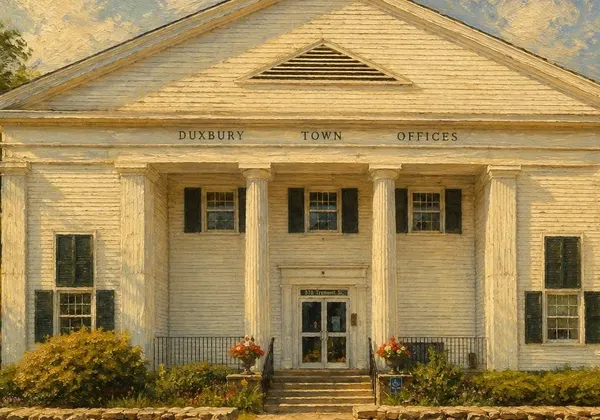
Get these sorted early and the town works smoothly. A transfer station sticker first, because there is no town-wide curbside pickup; the dump run is a social institution, and you will see your neighbors there; our transfer station guide explains the whole system. A beach sticker (our beach guide explains the whole access system). A dog license plus a separate beach walking permit if you have a dog; they are two different pieces of paper. Then the free stuff: register to vote at Town Hall, sign up for the Town's E-Alerts so meeting agendas and beach updates find you, and get a Duxbury Free Library card, which residents will tell you is one of the best-run operations in town. Our Live Local page walks through every sticker and permit with links to the official pages.
House stuff nobody mentions
Three things worth knowing before or just after you sign. Most of Duxbury is on private septic rather than sewer, which means Massachusetts Title 5 rules apply: a passing inspection is generally required when a home is sold, and system condition is a real line item in any purchase. Parts of town also sit in an aquifer protection district, which shapes what can be built where. And this is a coastal town in winter: nor'easters take the power out often enough that generators are common, and if you are buying near the water, spend an evening with the flood maps before you fall in love. None of this is unusual for the South Shore; it is just the homework the listing photos skip.
Schools, the actual structure
The schools are consistently among the reasons people move here, so here is the ladder: Chandler School (pre-K through 2, with tuition-free full-day kindergarten), Alden School (grades 3 to 5), Duxbury Middle School (6 to 8), and Duxbury High School (9 to 12). The middle and high schools share a building on Alden Street constructed in 2014. Teams are the Dragons, the colors are green and white, and Friday nights in fall are a town event. Current enrollment, registration, and calendar details live at the district's own site, which should be your source of record.
Getting to Boston
Be honest with yourself: this is a car town. Route 3 is the spine, roughly 35 miles to Boston with all the rush-hour caveats that implies. The rail option is the MBTA's Kingston station, one town over with a large park-and-ride lot, running commuter rail to South Station. Plenty of residents split the difference: drive off-peak, train on meeting-heavy days. Within town, GATRA provides regional transit service, and The Center runs transportation for older residents.
Plugging in
The information ecosystem, in order of usefulness. The Duxbury Clipper, the weekly paper published since 1950, is still the town's paper of record (subscription, print and digital). The Local Seen carries gavel-to-gavel video of town meetings on local cable and YouTube, which is the fastest way to understand how the town actually governs itself. The Town's E-Alerts deliver the official word. And Duxbury Helping Duxbury, the Facebook group running since 2013, is the town square: lost dogs, plumber recommendations, spirited debate. Read it for a few weeks before posting; you will learn the local physics faster that way.
Your first year
The rhythm arrives on its own, but here is the preview. Summer is the beach, full stop; learn the tides and the sticker system and you have learned the season. When guests arrive, hand them our perfect day itinerary. Fall brings the cranberry harvest flooding the bogs crimson, Friday night football, and a town that takes Halloween seriously (our Folklore page covers the local material). Winter is quiet, stormy, and the locals' favorite secret; the beach in January is empty and spectacular. Spring means Town Meeting, the annual exercise in direct democracy where registered voters walk in and decide the budget themselves. Go at least once, even just to watch. It is the town explaining itself in public.
The unwritten rules
Low tide is the best tide. The bridge is for walking slowly. Wave to people; they are probably waving at you. And yes, everyone really does care that much about the beach: 83% of residents named it the town's greatest asset in the Envision Duxbury master-plan survey. You'll get it after one summer.
Live local
Beach stickers, dog permits, transfer station passes, and every form Town Hall can throw at you.
The living chart
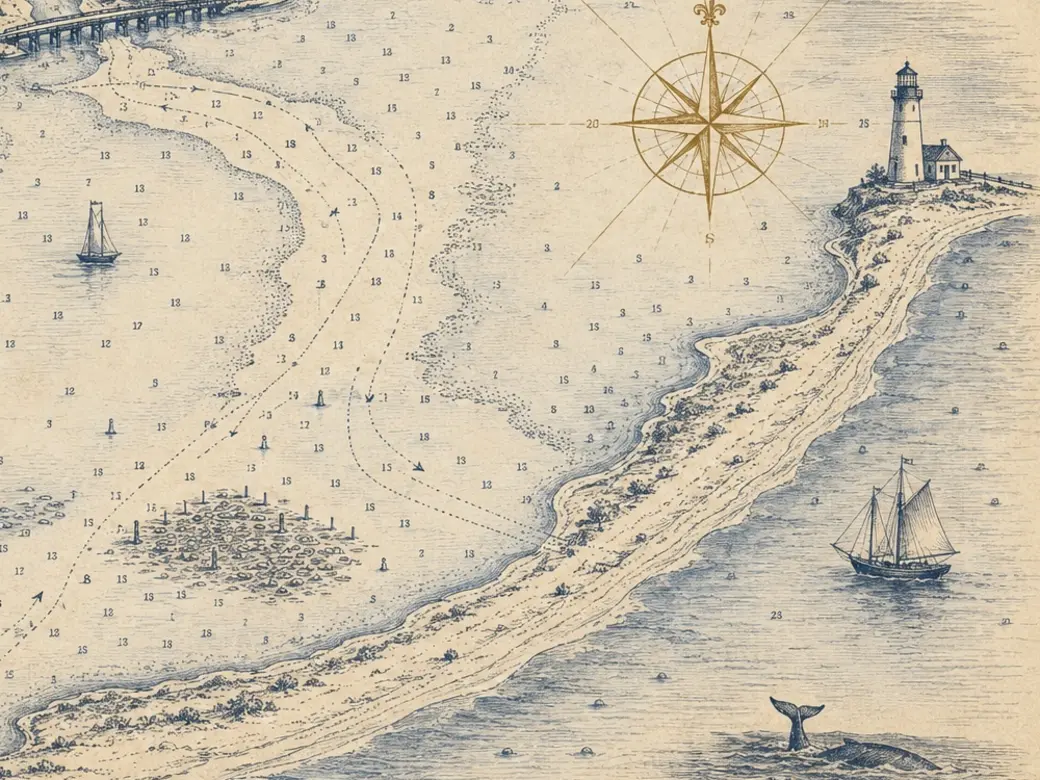
Landmarks, legends, villages, and walks, each pinned where it belongs on the bay.

Things to do
The beach, the bridge, the monument, and the right way to spend a Saturday here.