
The shipbuilder they called King Caesar.
For two generations, one family on Powder Point built an American shipping empire from a small town on a shallow bay. This is the story of the Westons, the ship Hope, and the nickname that stuck to a house.
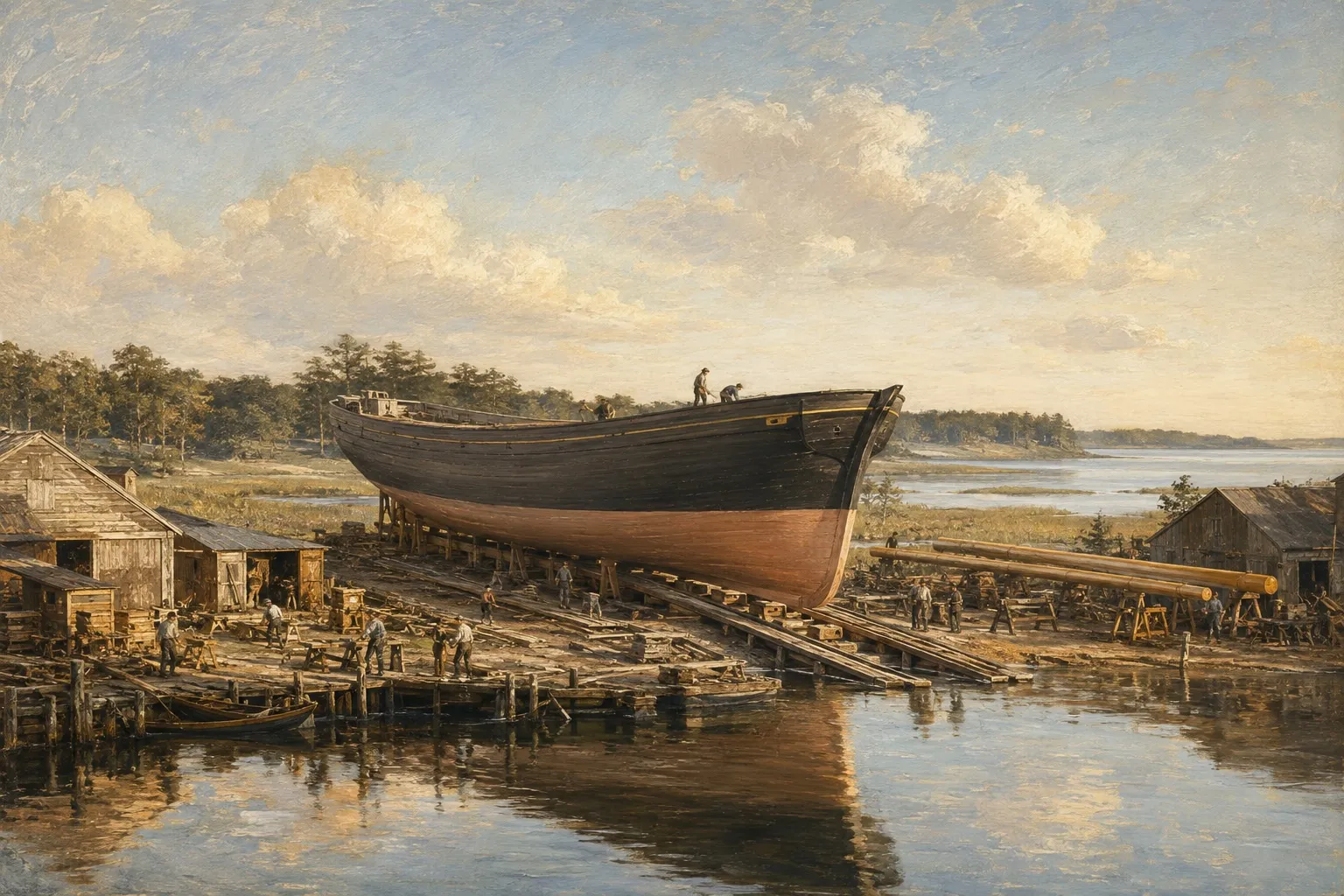 Launch day on the ways · Duxbury Uncommon illustration
The first Caesar
Ezra Weston began building small sloops and schooners on Powder Point in 1764. He had ambition to match his output, and his success in shipbuilding made him the wealthiest man in Plymouth County. Somewhere along the way, his forceful character and his grip on local affairs earned him a nickname with an edge to it: King Caesar. It is said he owned nearly half the town. The nickname was sharp enough to survive into a mock-Biblical parable written during an 1803 bridge dispute, in which "Caesar the King" makes his decree to the "Sodomites" across the river, a story told on Village Names.
The son who built the empire
His son, Ezra Weston II, joined the firm as a partner in 1798 and took full control when his father died in 1822. The nickname came with the inheritance, and the second King Caesar earned it on a larger stage. Under his sole ownership through the 1820s and 1830s, E. Weston & Sons became the largest mercantile operation on the South Shore: a ten-acre shipyard, a ropewalk, a sailcloth mill, a farm, and a workforce of sailors, carpenters, and laborers, all directed from the Federal mansion he built on Powder Point in 1809. He also had an eye for talent. The young master carpenter he hired to run his shipyard, Samuel Hall, later opened his own yard in East Boston and built some of the era's famous clipper ships.
The Hope, and the peak
Over three generations the Weston firm built or acquired more than 110 vessels, from a 25-ton schooner to the ship Hope, launched in 1841 at 880 tons: the largest vessel ever built in Duxbury, and the largest merchant vessel launched in Massachusetts up to that time. Lloyd's of London recognized Weston as the largest shipowner in America, and Daniel Webster said much the same in a speech that year. A town of a few thousand people, on a bay too shallow for the biggest ships it built, was for a moment a name known across the Atlantic.
After the king
Ezra Weston II died in 1842. His three sons ran the firm until 1857, without their father's talent for it, and the business wound down as steam and rail were ending the age of sail anyway. Two of the sons spent the family fortune; the third, Alden Bradford Weston, lived austerely in the great house and died there alone in 1880. The house survived him, though not quite as a private home again: a generation later it served as the headmaster's residence for the Powder Point School for Boys, a prep school built on the estate's grounds until it closed in 1926. Today the King Caesar House is a museum run by the Duxbury Rural & Historical Society, its front parlors still hung with the French wallpapers imported for its construction, a time capsule of the town's golden shipbuilding age. The Westons were not the only family building on this shore; the Drews, the Winsors, and Levi Sampson all launched vessels of their own, named and dated in the shipbuilding database.
Sources & verification
Drawn from the Duxbury Rural & Historical Society's history of the King Caesar House and historical sketch of Duxbury, and biographical records of Ezra Weston II. For the full story, Patrick T. J. Browne's book "King Caesar of Duxbury" is the definitive account. Spot an error? Tell us. Last verified: July 20, 2026.
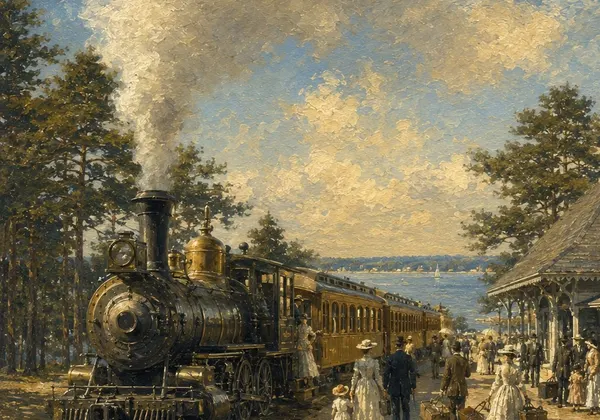
The summer resort era
A $1.50 ticket from Boston, the Myles Standish Hotel, and the town's resort age.
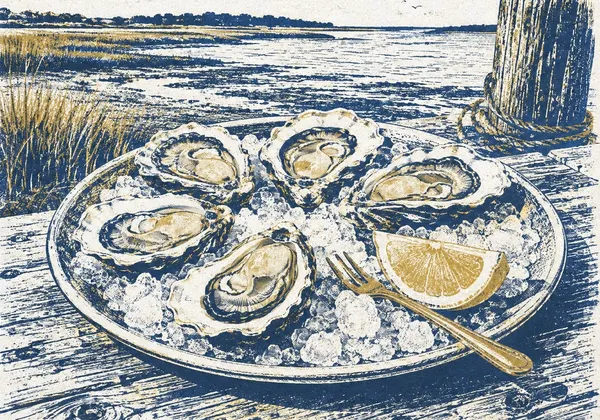
The oyster story
Why Duxbury Bay grows famous oysters, how the farms work, and where to eat and tour.

History & heritage
Plymouth Colony's second town: the Wampanoag homeland, twenty shipyards, and the families who built it.