
Sixty years, before anyone called it history.
In 1620 there was no Duxbury: just an empty shoreline north of a struggling colony. By 1680 there was a town with roads, a bridge, a mill, a minister, a militia, and a war behind it. This is the detailed record of how that happened, drawn from Plymouth Colony's own court records, Justin Winsor's 1849 town history, and the Duxbury Rural & Historical Society's archives. History has the short version; this is the long one.
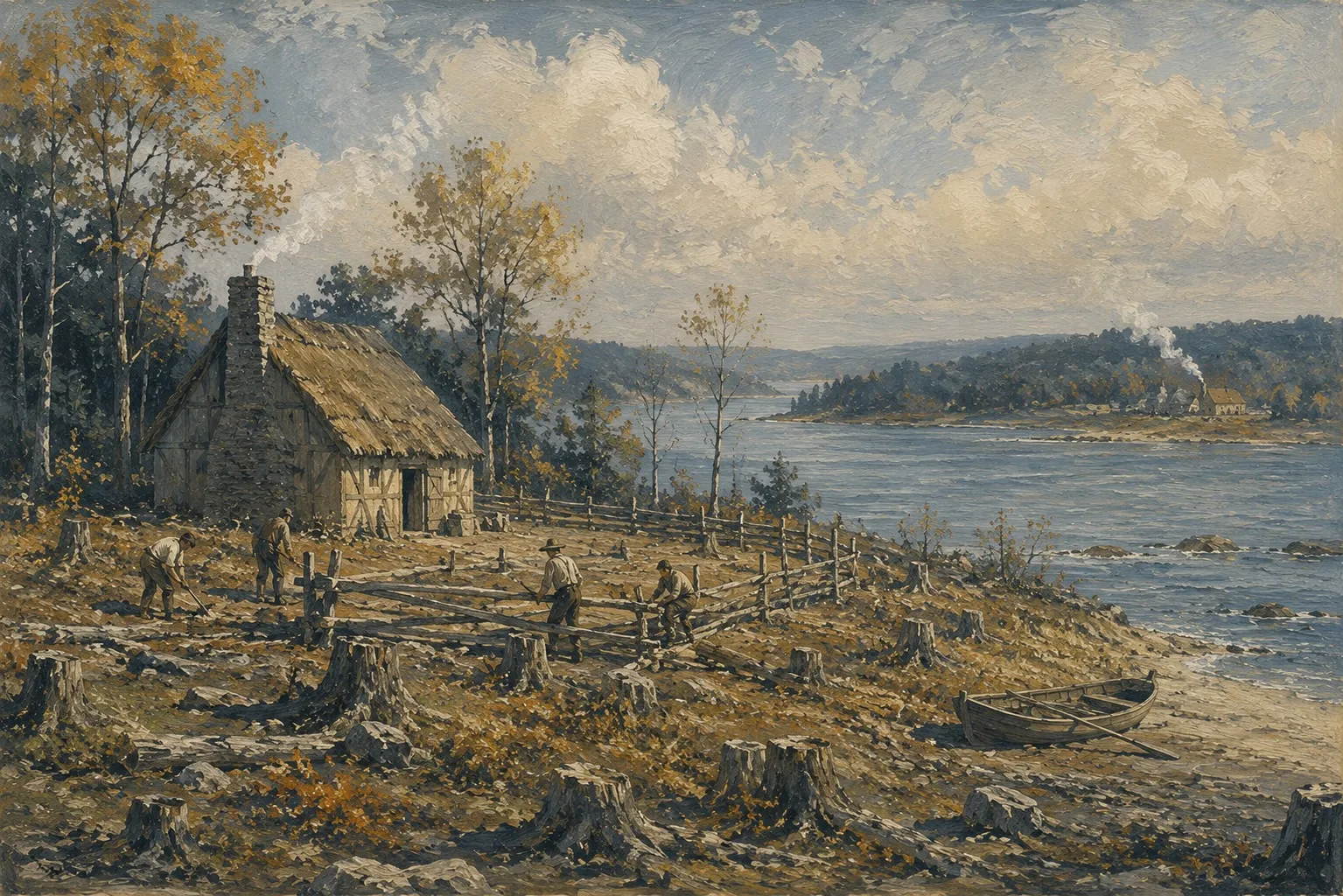 Cutting a farm out of the woods · Duxbury Uncommon illustration
Arrival & land grants (1620s)
A colony, not yet a town
The Mayflower's passengers land at Plymouth under a contract with their London financial backers that required everyone to live and work in common for seven years. No one could hold private land yet, which meant no one could start a Duxbury.
Hobomok moves in with Standish
Hobomok, one of Massasoit's own counselors, chooses to live inside Myles Standish's household as a guide and interpreter, and stays loyal to the English for the rest of his life. During the severe drought of 1623 he tells John Alden he fears the English will starve; when rain finally comes without the usual storms, he marvels that "your God is a good God." He dies in 1642, after two decades of service.
Wessagusset
Standish leads a raid on the Massachusett up the coast at Wessagusset, killing several men. The colonists called it a rescue; Massachusett descendants call it a massacre. Both versions are told in full on Myles Standish, the soldier and Mattakeesett.
The seven years end
Plymouth's communal contract expires, and colonists are finally free to hold private land. John Alden receives 100 acres on the Bluefish River; Standish and William Brewster take land nearby at a spot they call the Nook. All three keep their official residence in Plymouth for now, farming this new ground only in summer. The romance Longfellow later invented for this trio is fact-checked on the courtship, fact-checked.
The first year-round attempt, probably
Justin Winsor's history calls it "most probable" that some settlers were already living at Duxbury before any formal record says so, in temporary cottages they were glad to trade back for their sturdier Plymouth homes each winter.
They promise to stay through winter
On April 2nd, John Alden, Myles Standish, Jonathan Brewster, and Thomas Prence formally promise the Colony Court they will move their families to Duxbury year-round, "that they may the better repair to the worship of God." This is the moment the settlement stops being a summer camp. The same year, the congregation gathers under Elder William Brewster, becoming Plymouth Colony's second church body.
Becoming a town (1630s)
The town that almost un-founded itself
With Duxbury's population growing and both settlements exposed to danger separately, Plymouth's court seriously debates merging the two towns back into one, at a new site between them. A nine-person committee splits seven to two in favor of a spot near Jones River over one near Captain's Hill called Morton's Hole. The matter is handed to the two churches to settle between themselves, and then simply disappears from the record. Duxbury, as a separate town, survives by default.
Incorporation
On June 7th, the Colony Court enacts that "Ducksborrow shall become a towneship," Plymouth Colony's second incorporated town. It takes its name from Duxbury Hall in Lancashire, Standish's ancestral family seat, though at least two 17th-century writers spell it their own way: "Dukes Berry" and "Dukesbury."
The first road, and a stockade in the way
A twelve-person jury, four of them Duxbury men, lays out the town's first formal road, running from the Jones River ferry past a string of named residents' farms. One entry orders that Christopher Wadsworth's "pallasadoe is to be removed": his own defensive stockade is blocking the public way, and the town makes him move it.
First tavern license
Francis Sprague receives Duxbury's first license to keep a tavern, which is to say the town's drinking problem and its road-building problem get solved in the same year.
Meetinghouse and burying ground
The first meetinghouse goes up, and a burying ground starts beside it the same year, on what's now Chestnut Street. Ralph Partridge, newly arrived from England, becomes the town's first ordained minister. Full story on The Old Burying Ground.
A bridge you can drive a cart over
The bridge over Jones River is ordered made passable for carts: modest, but it's the town's first real piece of shared infrastructure, and the start of a maintenance headache that runs for decades.
The first gristmill
Thomas Hilier and George Pollard contract to build Duxbury's first water-powered gristmill, to grind both English and Indian corn. Before this, every bag of grain in town had to be hauled to Plymouth and back.
Growth & a widening map (1640s–1650s)
The bounds get fixed
The Colony Court formally fixes Duxbury's borders for the first time. The original township is enormous by later standards, reaching into land that will eventually become Marshfield, Pembroke, Hanson, and the Bridgewaters.
The first real population count
A militia muster lists 82 men able to bear arms, ages 16 to 60. Scaled up by the usual colonial ratio, that puts the town's total population somewhere over 400.
27 freemen
Twenty-seven men in Duxbury now hold full voting rights in colony affairs, a small number that will keep climbing for the rest of the century.
Fourteen miles square, paid for in coats and hatchets
On March 28th, Myles Standish, Samuel Nash, and Constant Southworth, acting "in behalf of all the townsmen of Duxbury," buy a fourteen-mile-square tract called Satucket from the Wampanoag sachem Massasoit (recorded here as Ousamequin), paying seven coats, nine hatchets, eight hoes, twenty knives, four moose skins, and cotton cloth.
The captain is buried
Myles Standish dies on October 3rd at his farm below Captain's Hill and is buried in the Old Burying Ground. The full, unvarnished account of his life is on Myles Standish, the soldier.
The land Duxbury bought becomes someone else's town
The Satucket tract, purchased seven years earlier "for" Duxbury, is incorporated as its own separate town: Bridgewater. The town's newest territory doesn't stay its own for long, a pattern that will repeat as Duxbury's original enormous footprint keeps shrinking into the neighbors it created.
A working town before the war (1660s–1675)
The bridge is declared dangerous
The Jones River bridge, patched together since 1638, is formally declared "dangerous for man and beast." It is not the last time a Duxbury bridge will earn that kind of headline.
Another repair
John Rowland and Constant Southworth are ordered to hire workmen and fix the bridge again.
A whole new bridge, finally
The town gives up patching and orders an entirely new bridge built over Jones River, twenty-seven years after the first one.
Ordinary road business, extraordinary names
A jury including George Soule Sr. and Philip Delano, both already familiar names on the town's oldest gravestones, lays out a footway through two neighbors' land. It is unremarkable town business, handled by men whose names now sit on a National Register-listed cemetery.
A border settled with Scituate
A long-running boundary question with Scituate is resolved, with Robinson's Creek fixed as the line between the two towns.
34 freemen, and the first school
The freeman count reaches 34, and Duxbury opens its first school, more than three decades after incorporation.
A marsh dispute, settled for good
A boundary argument with Marshfield over a stretch of salt marsh, dragging on for years, is finally resolved in June. The settlement, the record insists, shall be "a finall and perpetuall isshue" of the matter: a strikingly confident claim to make about a few acres of hay.
King Philip's War (1675–1676)
Clark's Island becomes a prison
As war breaks out across the region, the Colony's Council of War orders that Native people friendly to the English, recorded as "the Namassachusett Indians," be "speedily removed to Clarkes Island, and there to remaine and not to depart from thence without lycence from authoritie upon paine of death." The full story of that internment, and of the people it was done to, is told in full on Mattakeesett. Duxbury's own minister since 1655, John Holmes, dies this same year.
A new minister, a war ending
Ichabod Wiswall, later buried under carved sea monsters in a story told on Folklore, is settled as Duxbury's new minister the same year the worst of the fighting ends across southern New England.
Still standing
By 1683–84 the town's freeman count reaches 40, proof the community absorbed the shock of the war and kept growing. That's where this particular story ends, sixty years and one war after it began. What follows, the long quiet farming century and eventually a shipbuilding boom, is told in full on History.
Sources & verification
Drawn primarily from Justin Winsor's "History of the Town of Duxbury, Massachusetts" (1849), the same primary source the Duxbury Rural & Historical Society itself cites, cross-checked against the Society's own published local history and exhibition materials, and Plymouth Colony's court records as quoted therein. One claim we could not verify to our own standard, that Marshfield was carved directly out of Duxbury's territory, has been deliberately left out; the weight of evidence says Marshfield was settled and incorporated directly from Plymouth. Spot an error, or have a source we should see? Tell us. Last verified: August 5, 2026.
Mattakeesett
Ten thousand years of Native history on this shore, and what colonization actually did to it.
Myles Standish, the actual soldier
The hired sword of Plymouth Colony, the Wessagusset killings, and the farmer of the Nook.
The Old Burying Ground
Built 1638, the same year as the first meetinghouse: the resting place of half the names on this timeline.