
The love triangle Longfellow sold to America.
"Why don't you speak for yourself, John?" In 1858, a poem about three Duxbury founders became a national sensation. Here is what the poem says, what the record shows, and where the story actually came from.
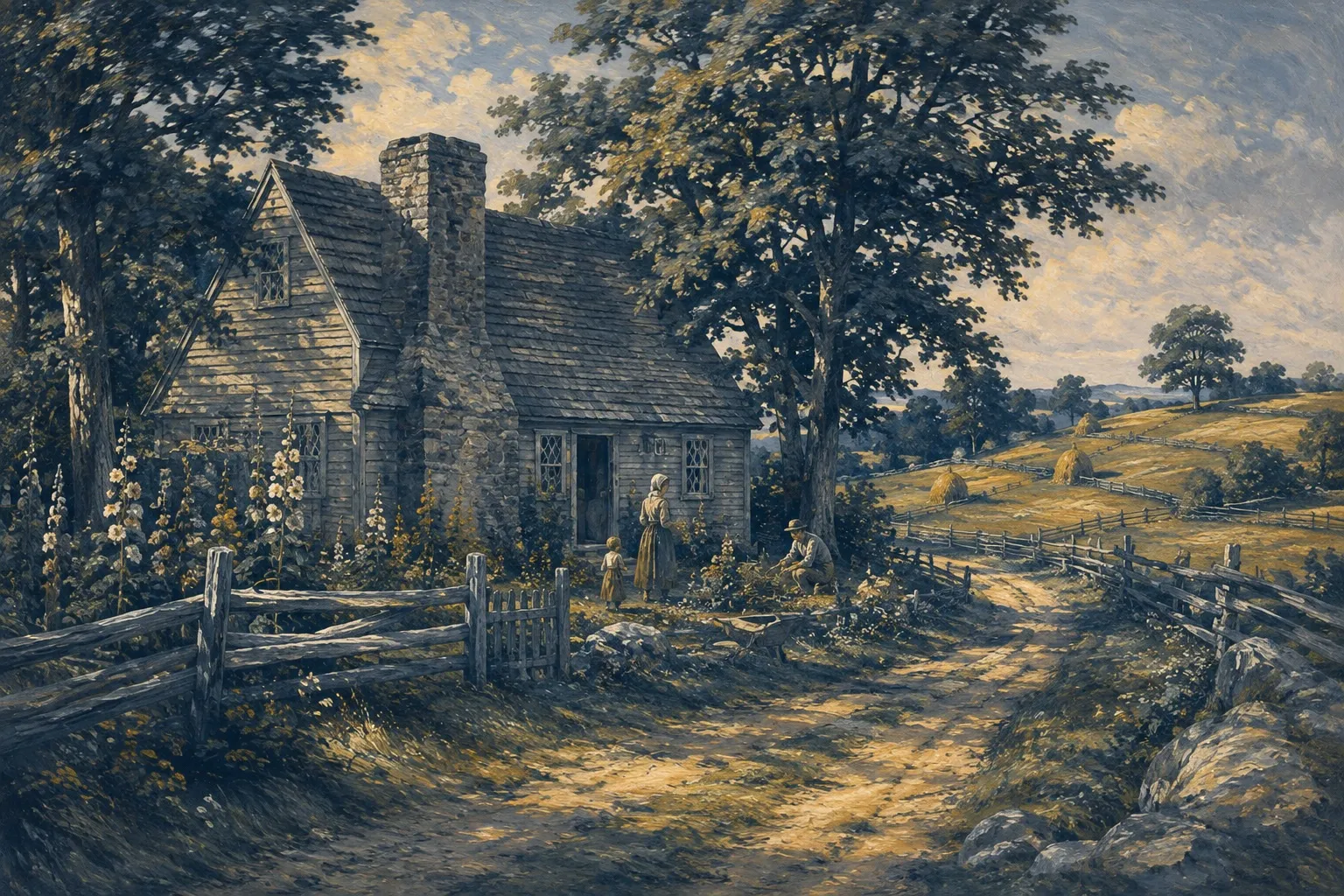 The Alden homestead, as it might have looked · Duxbury Uncommon illustration
The poem
Henry Wadsworth Longfellow published "The Courtship of Miles Standish" on March 1, 1858, and it sold tens of thousands of copies in its first year on both sides of the Atlantic. The plot is simple and irresistible. Captain Myles Standish, brave in battle and hopeless with words, asks his young friend John Alden to propose to Priscilla Mullins on his behalf. Alden, secretly in love with her himself, dutifully delivers the message, and Priscilla answers with the most famous rejection in American literature. Longfellow, a Harvard professor and the most popular American poet of his century, was himself a descendant of John and Priscilla Alden through his mother.
What the record actually shows
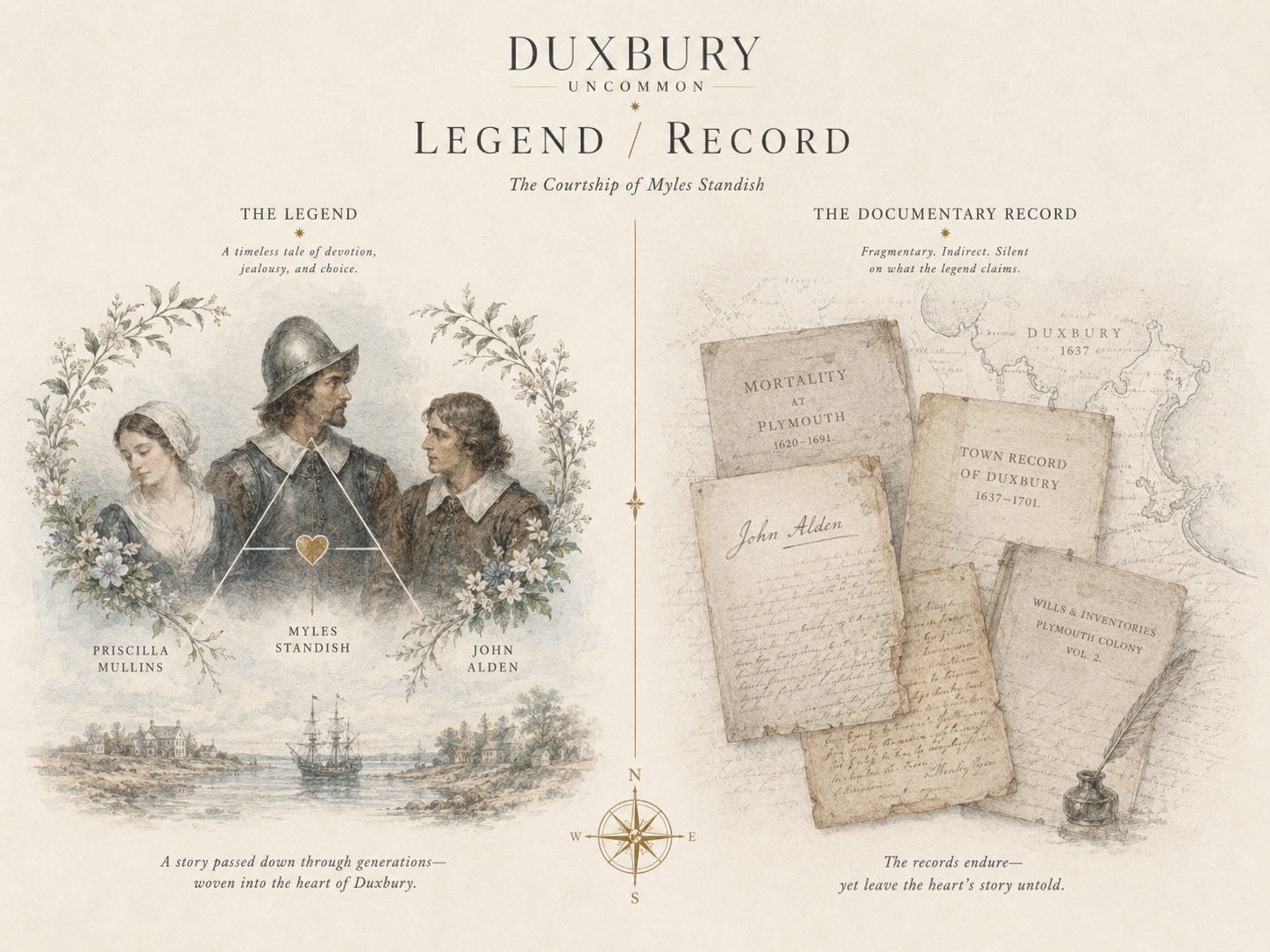
All three characters were real Mayflower passengers, and the outline of their world is documented. Standish's wife Rose died on January 29, 1621, in the brutal first winter that also killed Priscilla's parents and brother. John Alden and Priscilla Mullins did marry, probably before 1623, and raised ten children. Standish remarried a woman named Barbara around 1623. Both men helped found Duxbury when settlers moved north across the bay from Plymouth, and they lived out their lives here as neighbors. (For the harder side of the Captain's record, see Myles Standish, the actual soldier.) If there was ever a rivalry, it left no scar: when Standish died in 1656, his widow chose John Alden to take the inventory of his estate.
What the record does not contain is the triangle. No document from the period mentions Standish courting Priscilla, Alden serving as messenger, or the famous retort. Plymouth Colony's papers are silent on the whole affair.
Set the two versions side by side and the shape of it is clear: the people are documented, the triangle is not.
Where the story came from
The tale first appeared in print in 1814, in a collection of epitaphs and anecdotes compiled by Timothy Alden, another descendant, who presented it as a story "carefully handed down by tradition." Longfellow took that family tradition and, forty-four years later, gave it drama, hexameters, and an ending. Historians have never been able to confirm or refute it. The fairest verdict: a family legend, possibly rooted in something real, recorded two centuries after the fact and then thoroughly fictionalized by a master.
Why it mattered anyway
True or not, the poem changed how Americans saw the Pilgrims, turning distant religious separatists into people with rivalries and crushes. Its popularity helped push the Pilgrim story to the center of national identity in the years when Thanksgiving became a holiday. And it gave Priscilla something no other woman of Plymouth Colony received: she is remembered by name. In Duxbury, the legend has an address. The Aldens' original homesite, with archaeological remains of the house John built around 1630, sits on town land, and the surviving 17th-century house nearby, likely built by a grandson around 1700, is a museum still run by Alden descendants.
Sources & verification
Drawn from Pilgrim Hall Museum, the Smithsonian American Art Museum, Britannica, and the documentary record of Plymouth Colony as summarized by those institutions. The 1814 Timothy Alden text is quoted by Pilgrim Hall. Spot an error? Tell us. Last verified: July 20, 2026.
Standish the soldier
The real captain: hired soldier, Plymouth's protector, and the hardest questions about 1623.
Folklore
The sea serpent, the tentacled gravestone, and the rest of the town's legends, actually told.

Mattakeesett
Ten thousand years of Wampanoag history on the bay: the place of many fish.