
The oyster town, explained.
America's best-known oysters come out of this bay. Here is why the water does it, how the farms work, where to taste them, and exactly how to get a permit and dig your own dinner.
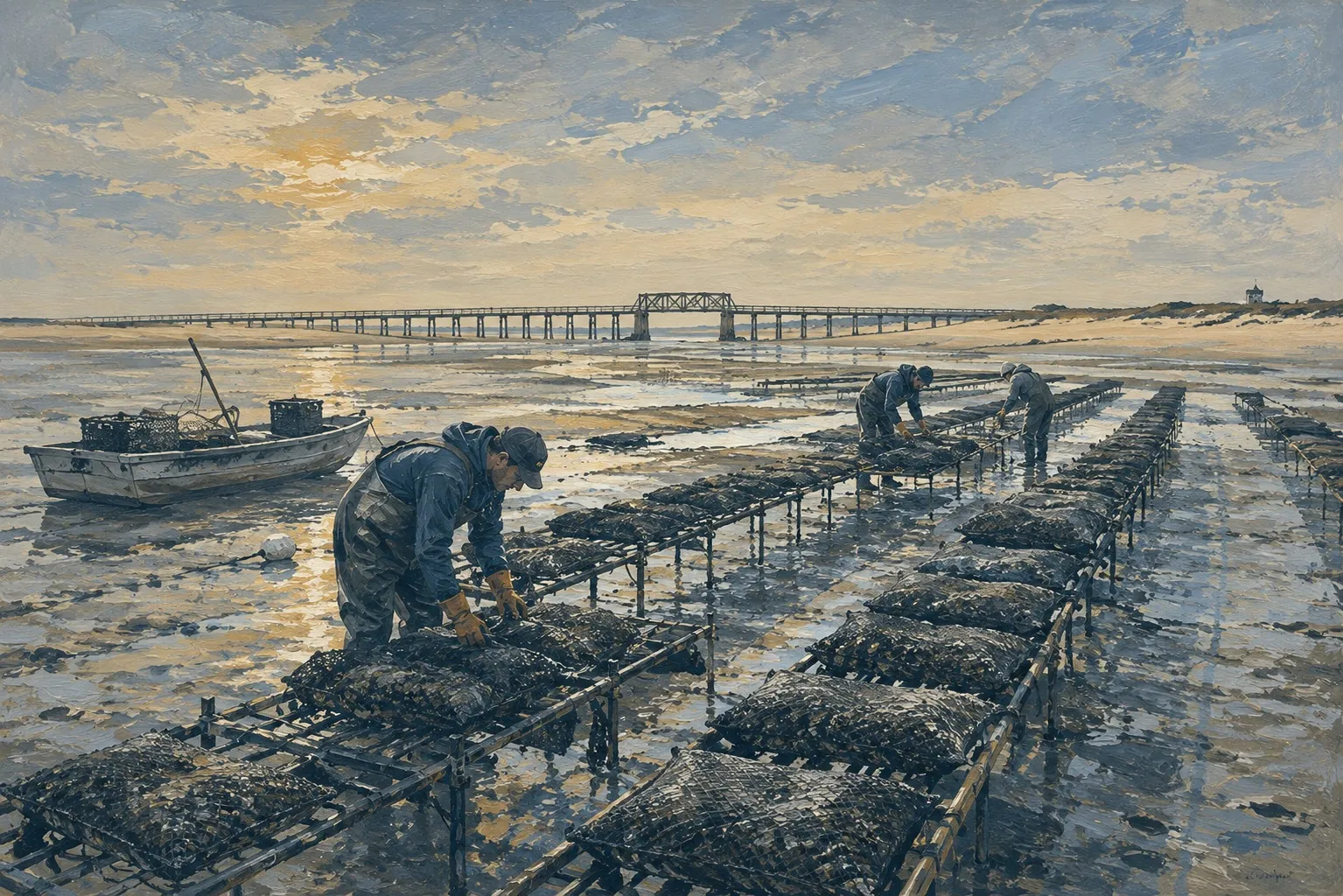 The farm at dead low · Duxbury Uncommon illustration
Why this bay makes that oyster
Duxbury Bay is shallow, clean, and flushed hard twice a day by some of the biggest tides on the East Coast. Cold water slows growth; slow growth builds flavor and a deep cup. The result is an oyster with real salinity and a clean finish, and a name (Island Creek, after the village and the creek) that sits on the menus of some of the best restaurants in the country.
The industry, briefly
Oyster farming took hold here in the 1990s and grew into the bay's defining industry. Today aquaculture in Duxbury employs more than 100 local residents full-time and year-round, alongside roughly 20 commercial wild-shellfish licenses for clams, quahogs, razors, and mussels. The farms are not just an economy: oysters filter the water as they feed, and the local water-quality community credits the beds with helping keep the bay healthy. Grants of bottom out on the flats, tended at low tide in every season, are as much a part of the working landscape as the cranberry bogs inland.
Taste it, tour it, buy it
The complete Duxbury oyster experience has three parts. Eat them at the raw bar on the waterfront, where the distance from bay to plate is measured in hours. Tour the farm: Island Creek runs seasonal boat tours out onto the flats where you can stand on the grants at low tide. And take some home from the oyster shop with a shucking lesson from whoever is behind the counter. If you learn to shuck, you will never look at a raw bar bill the same way.
Dig your own: the recreational permit
Duxbury lets residents and visitors harvest shellfish recreationally, and it is one of the most Duxbury things you can do. The system, per the Town's rules: everyone over 14 needs a recreational shellfish permit, issued by the Municipal Services Office on the second floor of Town Hall (you can apply online). Family limits run 12 quarts per week for quahogs, mussels, and razor clams, which are open year-round. Soft-shell clams (steamers) and oysters are limited to 6 quarts per week within that total, and steamers may only be dug in April, May, September, and October on Wednesdays and Saturdays, with bonus winter days sometimes voted in. The oyster season varies year to year; call the Harbormaster at 781-934-2866 before you go. Digging is by hand or conventional tined tools, harvesting is banned from a half hour after sunset to a half hour before sunrise, nothing harvested recreationally may be sold, and, a detail that catches people: a shellfish permit is not a parking permit.
Sources & verification
Drawn from the Town of Duxbury Harbormaster and Shellfish Constable rules and recreational shellfish guide, and the Duxbury Bay water-quality project's aquaculture pages. Seasons, limits, and open areas change; the Town is the controlling authority. Spot an error? Tell us. Last verified: July 21, 2026.
Eat & drink
Where locals actually eat, and why Duxbury oysters ended up on menus from Boston to Tokyo.

Walk the flats
A daily answer to one question: can you walk the bay flats today?

Things to do
The beach, the bridge, the monument, and the right way to spend a Saturday here.