
The town that used to be here.
A grand hotel with its own pier and spring. Two schools that don't exist anymore, one of them hiding inside a building you already know. Twenty shipyards that left almost no trace. A real railroad, absorbed into the ground under ordinary streets. None of this is folklore. It all happened, and then it was gone. Four of these sites are now pinned on the living chart, on their own Lost layer. A few of these facts also turn up, alongside dozens more, on the Uncommon 100.
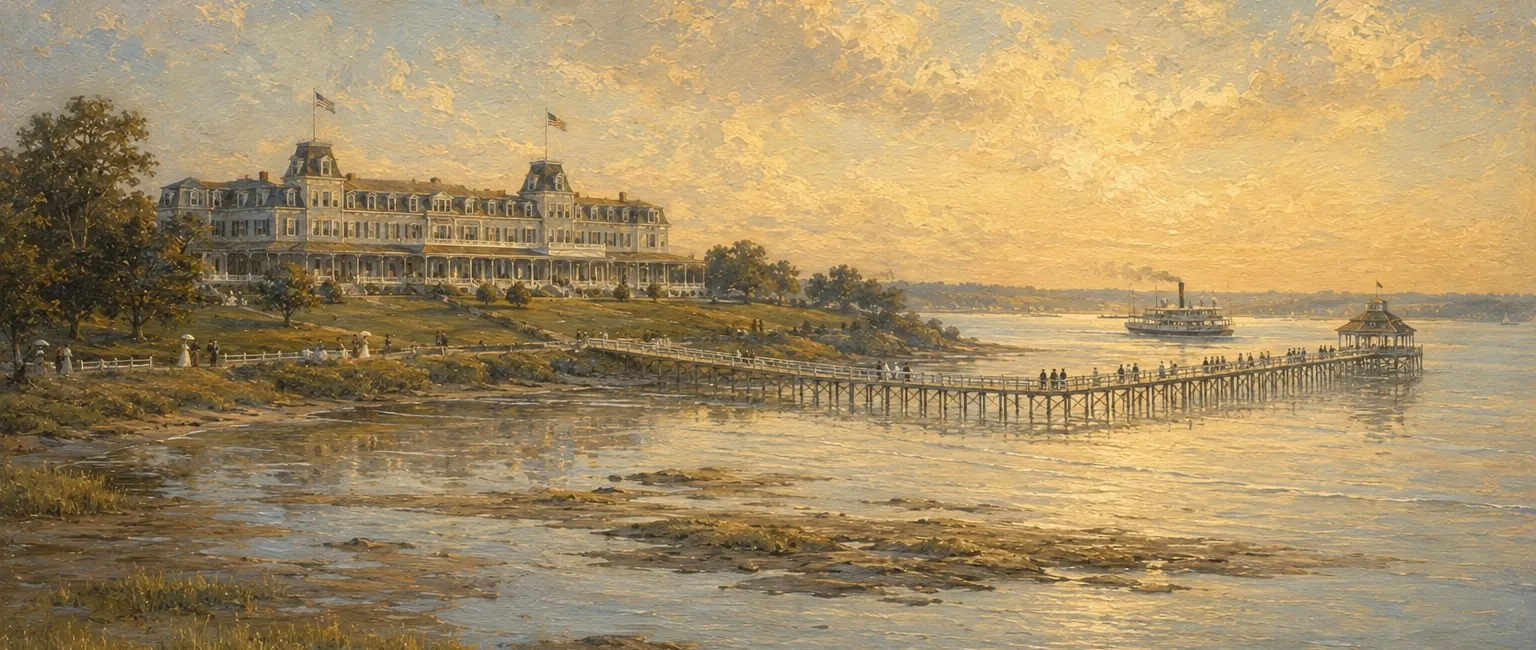 The Myles Standish Hotel and its pier · Duxbury Uncommon illustration
The Myles Standish Hotel (1871–1900s)
In 1871, a group of Boston investors formed the Standish Shore Company and built a grand hotel on land that had actually belonged to William Brewster, not Standish, but tourists knew the Standish name and the company knew it. The Myles Standish Hotel had a golf course, daily concerts, weekly balls, and hosted regattas out of the adjacent Duxbury Yacht Club. Guests walked a 400-foot pier down to a spring, the hotel's own water supply, famous enough to appear on the trade cards advertising the place. A planned cottage colony around it never fully materialized. The hotel is long gone. What survives today, on Standish Shore, are two private residences built from its remains.
Partridge Academy (1844–1933)
George Partridge, a Duxbury-born congressman, died in 1828 and left the town $10,000 to found a school. Partridge Academy opened on Tremont Street in 1844 and was Duxbury's only secondary school for more than 80 years, until the town finally built its own high school in 1927. The Academy burned in 1933. Its old site on Tremont Street is now occupied by the Duxbury Town Offices, which means the town has been governing itself from a dead school's foundation for most of a century.
The Powder Point School for Boys (1893–1926)
A private college-prep academy, built by Frederick Bradford Knapp on the former estate of Ezra “King Caesar” Weston Jr., a generation before that house became a museum. The school survived a disastrous fire in 1913, was sold in 1910 to brothers John and Philip Moulton, and closed in 1926 when it merged into Tabor Academy in Marion. Its dormitory building briefly became the National Sailors' Home before being torn down in the 1970s. Its headmaster's house is still standing, and you have likely already read about it: it is the King Caesar House.
The shipyards of Washington Street and the Bluefish River (1790s–1874)
At the industry's peak in the 1830s, close to 40 shipyards worked this shore; by the 1840s, roughly 20 remained, still enough to make Duxbury the largest producer of sailing vessels on the South Shore. Ezra Weston II ran his from what he called the “Ten Acre Yard” on the Bluefish River. Washington Street itself exists because of this industry: laid out in 1798 over the objections of most of the town, and not completed until 1803, purely so shipbuilders could move materials along the waterfront. The last vessel built in Duxbury, the barque Thomas A. Goddard, launched in 1874 from what is now Shipyard Lane Beach. One yard's wharf had a stranger afterlife than most: sold in 1865, it ran for decades as a coal and lumber company, then a marine railway, and in 2000 became the Duxbury Bay Maritime School. The shipyards themselves left almost nothing behind. The captains' houses they paid for still line the street.
The Duxbury & Cohasset Railroad (1871–1939)
For 68 years, a real train connected Duxbury to Boston: three stops in town, a $1.50 round trip, absorbed into the Old Colony system within a decade of opening. Passenger service south of Greenbush ended in 1939, and the rails came up not long after. Stretches of the old rail bed now sit beneath ordinary roads and subdivisions, unmarked ground that most people driving over it today have no idea used to carry a train.
Sources & verification
Drawn from the Duxbury Rural & Historical Society's published local history and "You Are Here" historical marker project, the Drew Archival Library's Powder Point School finding aid, the Town of Duxbury's own town history page, and the National Register of Historic Places listing for the Old Shipbuilder's Historic District (1986). Spot an error, or know of something else that belongs on this list? Tell us. Last verified: August 5, 2026.
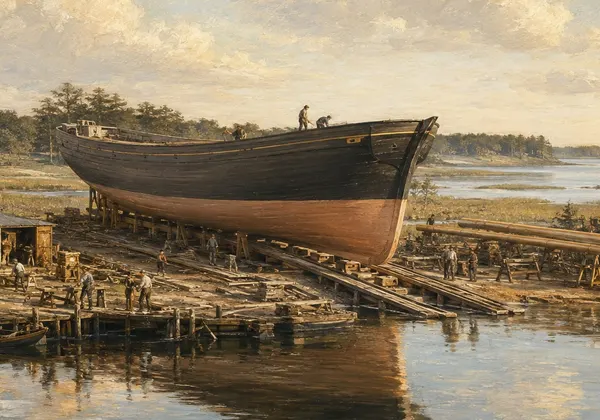
The shipbuilding age
Ezra Weston II, the ship Hope, and the fleet that briefly made a small town famous.
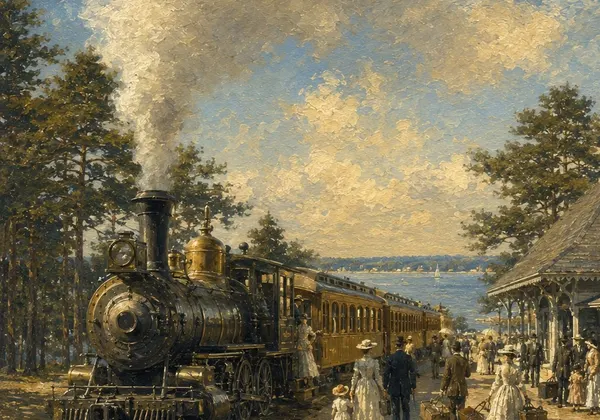
The summer resort era
How an 1871 railroad, a $1.50 ticket, and a grand hotel rescued a dying town and invented modern Duxbury.
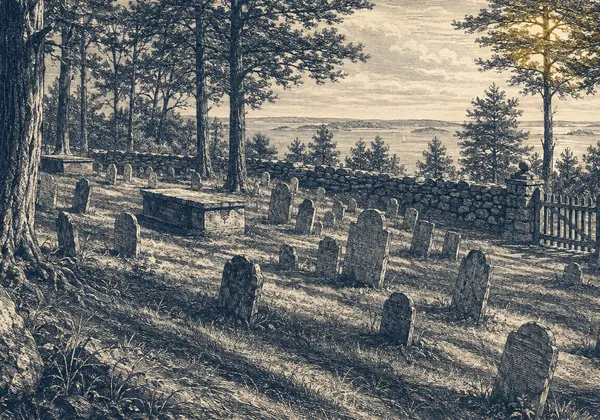
The Old Burying Ground
Built 1638, abandoned by 1789, forgotten for a century: how a family plot became the oldest maintained cemetery in the country.