
The sky over the bay.
Duxbury has one of the better front-row seats on the South Shore: a huge open horizon across Cape Cod Bay to the east and south, and a long barrier beach with remarkably little artificial light. This page tracks what is happening up there each month: sky events you can see from town, and the constellations worth learning right now. Refreshed monthly. For the horoscope, see Astrology.
LAST UPDATED: OCTOBER 1, 2026 · COVERING OCTOBER 2026
Moon phase and sunset computed for Duxbury, 42.04°N · predictions, not observations.
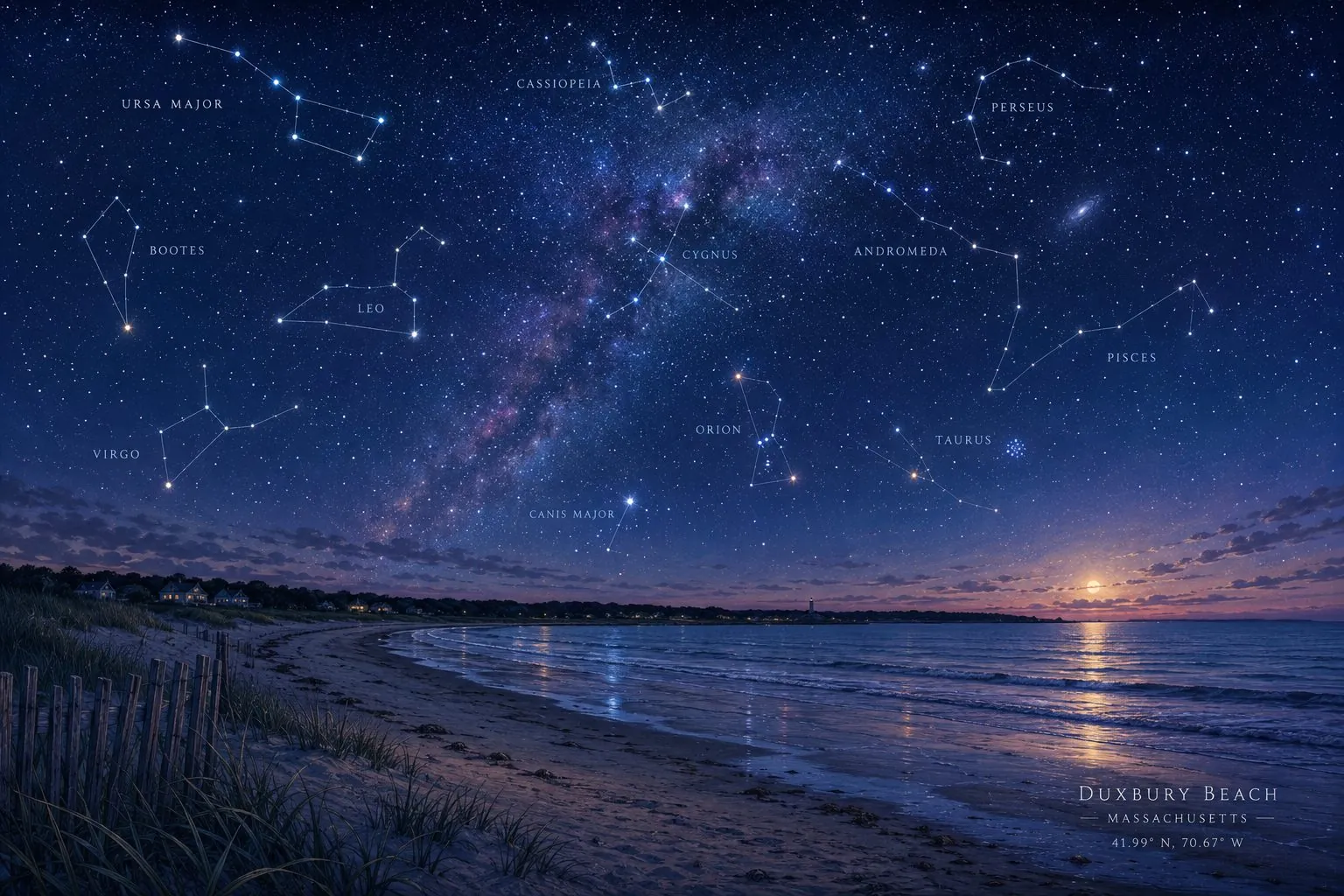 The night sky over Duxbury Beach · Duxbury Uncommon illustration
Saturn gets the month. Jupiter gets one hour.
October is a planet month. Saturn reaches opposition on the 4th, which means it rises at sunset, stays up all night, and is as bright and close as it gets this year. Before dawn on the 6th, the moon passes directly in front of Jupiter as seen from Duxbury, the kind of thing most people only ever read about. The month ends with the Hunter's Moon and a run of 12-foot tides. The chart shows the southeastern sky from the beach around 10 p.m. in mid-October.
The October sky calendar
Everything below is visible from town with your own eyes, weather permitting. Times are local, computed for Duxbury and cross-checked against published almanacs; a minute or two either way is normal. Clocks fall back on Sunday, November 1, so these are the last times of the year on daylight time.
The moon swallows Jupiter
A thin waning crescent, about a fifth lit, climbs the eastern sky with Jupiter sitting right on its edge. At roughly 4:27 a.m. the moon's bright limb slides over the planet and Jupiter simply goes out, like someone pinched a candle. About an hour later, around 5:31 a.m., it pops back out from behind the dark side, which is the better half of the show because there is no glare to fight. Both moments happen well above the horizon and an hour or more before the 6:45 a.m. sunrise. Binoculars make it much easier to catch the exact second; a small telescope will show Jupiter's disk going in a sliver at a time. The morning before, the 5th, the moon sits between Jupiter and Mars, a nice warm-up if the 6th clouds over.
Saturn at opposition
Earth passes between Saturn and the sun, so Saturn rises as the sun sets and is up all night. Look southeast after dark for a steady, pale-gold point well below the Great Square of Pegasus, brighter than anything around it in that dim stretch of sky. The rings are tipped only about seven degrees toward us this year, so a backyard telescope shows them as a narrow ellipse rather than the full hat-brim. Still worth a look. Opposition is a date, not a night: Saturn stays well placed all month.
The Draconids
The odd one out among meteor showers: the Draconids are best at nightfall, not before dawn, because their radiant in the northern sky is highest in the evening. Expect a handful an hour, maybe 10 to 15 at a good site, with the moon nearly new and out of the way until 5:40 the next morning. Most years this shower is modest. Every so often it throws an outburst, which is reason enough to look north for half an hour after supper.
Mars walks through the Beehive
Mars passes in front of the Beehive Cluster, a loose spray of stars in Cancer, high in the southeast before sunrise. The cluster is a faint smudge to the naked eye from a dark spot; in binoculars it resolves into dozens of stars with an orange planet parked among them. The new moon on the 10th keeps the sky dark.
The Orionids
Debris from Halley's Comet, arriving at up to 20 meteors an hour from a dark site. This year a bright waxing moon sets around 2:57 a.m., so the useful window is the last couple of hours before dawn, facing east or southeast with Orion climbing. Orionids are fast and often leave short trains. Thinner than August, but the sky is darker earlier and the bugs are gone.
The Hunter's Moon, then the big water
The moon rises at 5:09 p.m. on the 25th, about half an hour before sunset, so it comes up over the bay while there is still color in the sky. Turns full officially just after midnight. Two days later the moon makes its closest pass of the month, and together they push the biggest tides of the month: just over 12 feet on the afternoons of the 28th and 29th. Details on our tide calendar.
One planet is missing from the list on purpose. Venus passes between Earth and the sun on the 23rd and spends the whole month lost in the glare, then returns as a brilliant morning star in November. Mercury is technically in the evening sky but sits too low in twilight to bother with from this latitude.
The October scorecard.
Worth setting an alarm? For the 6th, yes. Jupiter going out behind the moon is the kind of thing you remember.
Our judgment, not a scientific instrument.
Learn the October sky in five minutes.
Five steps, any clear evening this month, from the beach or the end of your driveway.
- Face southeast and find the Great Square of Pegasus, four stars in a big box high up.
- Drop straight down from the Square to Saturn, the brightest steady light in that part of the sky.
- Keep going down to Fomalhaut, alone and low over the water.
- From the Square's top left corner, follow the chain of Andromeda up and left toward Cassiopeia's W.
- Turn west and say goodbye to the Summer Triangle, sinking a little lower every week.
Constellations this month
October is the hand-off. The summer stars are leaving in the west and the winter ones have not arrived yet, which leaves the middle of the sky to the dim, watery autumn constellations. From the beach around 10 p.m.:
High in the southeast: the Great Square. Pegasus is a huge, nearly empty box of four medium-bright stars, bigger than people expect. Once you find it, it becomes the anchor for the whole autumn sky.
Below it, over the water: Saturn and Fomalhaut. Saturn is the bright one this year. Lower still sits Fomalhaut, often called the loneliest star in the sky because nothing bright keeps it company. The surrounding constellations are the sea creatures: Pisces, Cetus the whale, Aquarius. It is a fitting part of the sky to have over Cape Cod Bay.
Northeast: Andromeda, Cassiopeia, and Perseus. From the Square, a curved line of stars runs up toward Cassiopeia's W. Halfway along, on a dark night, a small oval smudge is the Andromeda Galaxy, two and a half million light-years off and the farthest thing you can see without help. Later in the evening the Pleiades rise in the east, the first hint of winter.
West: the Summer Triangle, on its way out. Vega, Deneb, and Altair are still up after dark, tipping toward the mainland, and the faded summer Milky Way goes with them.
A local tip: our darkest sky is to the east and southeast, out across Cape Cod Bay, which is exactly where this month's action is. The glow in the northwest is Boston and Route 3. Face the water and let the mainland argue with itself behind you.
What it actually looks like.
Astronomy photography ruins expectations. Long exposures stack minutes of light into one frame; your eyes do not work that way. Here is what this month's events actually look like from a Duxbury beach.
Saturn
To the naked eye, a steady cream-colored star that does not twinkle much. In binoculars, slightly oval. In a small telescope, the rings, narrow this year, and possibly Titan as a faint dot alongside.
The Jupiter occultation
Jupiter does not fade; it goes from there to gone in a few seconds as the moon's edge covers its disk. Reappearance is just as quick. Be watching a minute early.
The Andromeda Galaxy
A small, faint, fuzzy oval, easier if you look slightly to one side of it. Not the spiral from the posters. Still the oldest light most people will ever see.
Where to look from Duxbury.
Face the water from the beach. The darkest, broadest horizon in town, and this month it holds Saturn, the Hunter's Moon rising, and the Jupiter occultation.
Where to face for the Draconids on the 8th, and for Cassiopeia and the Big Dipper year-round.
Greater Boston and Route 3 throw enough skyglow that this is the direction to turn your back on, not toward.
Before you go.
- Dress for a month later than the calendar says. The beach after dark in October is cold, and colder at 4:30 a.m.
- Bring a chair or a blanket, and something between you and the damp sand.
- Skip the bright white flashlight. Red light, or your phone turned all the way down, keeps your night vision intact.
- Give your eyes twenty to thirty minutes to adjust before judging what you can see.
- Binoculars help a lot with the occultation, the Beehive, and Andromeda. They make meteor watching harder, not easier.
- Check the tide before you set up near the water, especially the last week of the month. Those 12-foot highs reach the wrack line and then some.
Looking for the horoscope?
The sky calendar and constellation guide above are astronomy; the star signs are astrology, and they keep separate quarters here. Find this month's readings, written fresh for this town, on the Astrology page.

Tides
The month's full tide chart for Duxbury Harbor: every high and low, king tides flagged, moon phases marked.

Walk the flats
A daily answer to one question: can you walk the bay flats today?
Astrology
Twelve signs read fresh each month, with a South Shore accent.