
The Myles Standish Monument, head and all.
A 116-foot granite shaft with a 14-foot captain on top, built over 26 stubborn years on the hill where Standish farmed. It has survived a funding collapse, a change of granite, and one direct lightning strike that cost the captain his head. The whole story, and how to climb it.
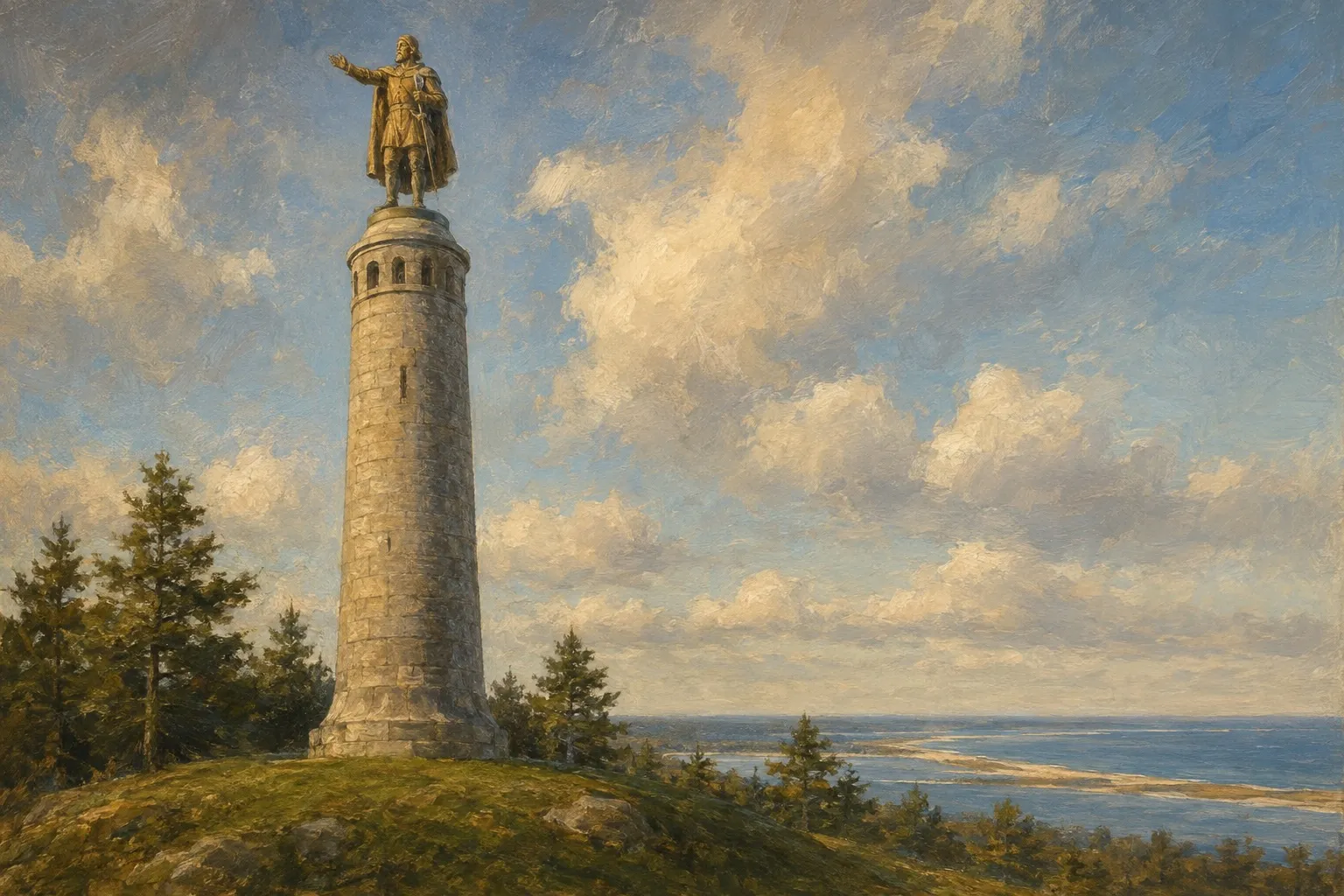 The monument, head and all · Duxbury Uncommon illustration
What you are looking at
The monument stands on Captain's Hill, two hundred feet above the bay and the highest ground in town, on land that was once Captain Standish's own farm. The shaft rises 116 feet from its base to a small viewing parapet, and the 14-foot granite captain above it faces east across Massachusetts Bay with the colony's charter in his hand. You can pick him out from almost anywhere on the water, which was the point. From the top, the view runs from the Blue Hills to Plymouth Harbor, with Duxbury Beach stretched out below and Cape Cod on the horizon on a clear day.
Twenty-six years, two granites
The project began the way most Gilded Age monuments did: with a poem. Longfellow's Courtship of Myles Standish had made the captain a national celebrity in 1858, and by 1872 the Standish Monument Association was ready to put him on a pedestal for real. On October 7, 1872, a crowd of ten thousand climbed the hill to watch the cornerstone laid. President Grant donated the keystone over the entrance, set in an arch built with a stone from each New England state, and a course of stones near the top of the base names the Massachusetts counties.
Then the money ran out. After $27,000 the shaft stood 72 feet tall, and it stayed that way for years. When work restarted in 1889 the builders could not match the original granite, and the seam is still visible about halfway up: the monument wears its funding history on its face. Architect Alden Frink's tower was finally completed in 1898, twenty-six years after the cornerstone. At the time, the only American memorial to a single citizen that outranked it was the Washington Monument.
The day the captain lost his head
On August 26, 1922, a summer thunderstorm put a bolt of lightning into the statue and knocked the captain's head and arm to the ground. Nobody hurried to fix it. Standish stood headless over the bay for four years, until Boston sculptor John Horrigan carved a replacement in 1926. Then the lightning-damaged legs proved too weak to carry the new head, so the statue went back to the quarry for stronger ones, and a largely rebuilt captain was hoisted back onto his perch in 1930. The strike is often misdated to 1903, 1920, or 1924; the Drew Archival Library, which holds the photographs of Horrigan with the new head, fixes the date from the Boston Globe's report the next morning.
Climbing it
The reservation has been state property since 1920 and is run today by the DCR. The grounds are open to walkers every day from dawn to dusk, free, with wooded trails up the hill and picnic tables in summer. The tower itself keeps banker's hours: weekends from 9 to 5, Memorial Day weekend through Labor Day, weather permitting. Rain or heavy wind closes it, staffing sometimes does the same, and locals have learned to treat an open door as a small win. Inside, 125 granite steps spiral up to the parapet. Children need an adult, and there is no elevator; the tower is not wheelchair accessible.
Parking at the top of the park road is free when the gate is open. Off season, park by the Crescent Street entrance and walk up. And a note for pilgrims of the literal kind: the captain is not buried here. His grave is in the Myles Standish Burial Ground on Chestnut Street, about a mile and a half north, in what the American Cemetery Association calls the oldest maintained cemetery in the country. That story deserves its own page, and it will get one.
Sources & verification
Drawn from the DCR's official page for the reservation, Mass Moments' account of the 1872 dedication, the Duxbury Rural & Historical Society's exhibition notes, and the Drew Archival Library's research on the 1922 lightning strike, cross-checked against standard references. The Society's exhibition pages credit the statue to sculptor Stephen J. O'Kelley, carved by Stefano Brignoli and Luigi Limonetta; the Drew Archives render the name S. J. Kelly. We follow the exhibition pages. Hours and access rules are the DCR's to change; check before you count on the climb. Spot an error? Tell us. Last verified: July 23, 2026.
Myles Standish, the actual soldier
The hired sword of Plymouth Colony, without the varnish.
The Courtship of Myles Standish
The 1858 bestseller that made the captain famous enough to deserve a tower.
Things to do
The rest of the list, from the flats to the bridge.