
The stories that refuse to die.
A United States senator sworn to silence by something in the bay. A Pilgrim minister buried under carved tentacles. A lighthouse keeper still at her window two centuries on. These are the stories Duxbury has told for three hundred years, and here they are told in full. None of them needs to be true. They only need to be told.
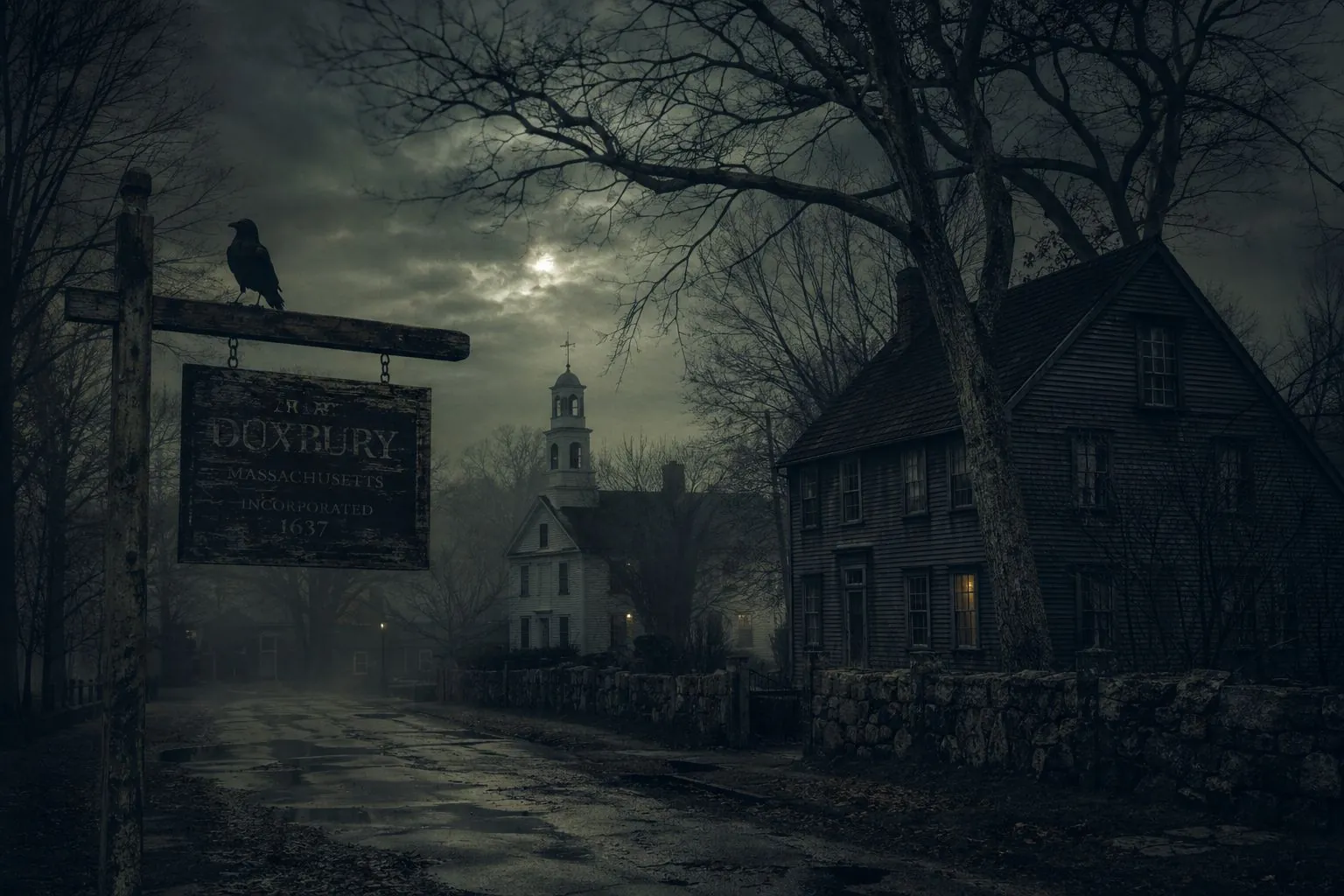 Duxbury as the stories remember it · Duxbury Uncommon illustration
A note on the rules of this page. What follows are the stories themselves, told the way they have always been told, with all the drama they have earned in the retelling. After each one, a few plain sentences on what the record actually shows. The fully documented past lives on the History page. This page is for everything the documents cannot vouch for, which is usually the good part.
The senator and the sea serpent
There was an old man in Plymouth, years back, who looked out at the bay through his spyglass every morning before breakfast, as regular as the tide. One morning the glass stopped moving. Out in the water between Manomet and Plymouth Beach, something was crossing the bay. Its head rode six feet above the surface and looked, he would say ever after, somewhat like a horse's. Behind it trailed a body the size of a cask, and it was not drifting. It was hunting. It careered across the bay after the mackerel, and the mackerel were so afraid of it that whole schools ran themselves up onto the sand and died there in heaps rather than stay in the water with the thing.
People remembered that story on the day it happened again, because of who it happened to. Daniel Webster, the greatest orator in America, the man who argued with the Devil himself in the tall tales, kept his farm one town up and fished these waters with his Duxbury boatman, Seth Peterson. One summer day Webster went down to Manomet to fish with some Plymouth gentlemen, and when the fishing was done he and Peterson set sail for home in Duxbury. Somewhere on that crossing, the water opened, and there it was: the horse's head, the cask-round body, the whole creature answering the old accounts in every particular, looking back at the most famous man in New England.
And here is the part every teller of this story loves best. Webster, who had faced down the Senate and the Supreme Court without blinking, turned to his boatman and made him swear an oath. Say nothing. Not a word, not ever. Because a man can survive being wrong about the tariff, but no man in public life survives being the fellow who saw the sea serpent. Peterson kept the secret about as well as secrets are kept in a small town, which is to say the whole South Shore knew within the year.
The story would not stay put. The writer Stephen Vincent Benét, who had already sent Webster up against the Devil, wrote a tall tale called "Daniel Webster and the Sea Serpent" in which the creature trails the great man home, takes up residence in the Green Harbor River, scares the livestock half to death, and turns out to be in love with him. Webster, being Webster, talks his way out of it and finds the lovesick serpent an honorable posting at sea. Duxbury Bay has been keeping an eye on the horizon ever since.
What the record shows: one entry in Henry David Thoreau's journal, June 1857, recording the story secondhand from a Plymouth man who had it on what he called pretty good authority. That is the entire documentary trail. The rest is the retelling, and the retelling has never once stopped.
The tentacles on the minister's gravestone
Rev. Ichabod Wiswall was the least whimsical man in seventeenth-century Duxbury. He was the pastor of the town's church for a quarter century, a man trusted enough to sail to London beside Increase Mather and argue for the colony's charter before the Crown. He preached what is remembered as the first funeral sermon in New England. When he died in 1700, the town cut him a slate headstone, the second-oldest carved stone in the Old Burying Ground, and on that stone, above the name of this sober servant of God, the carver put sea monsters.
Go look. Across the top of the stone swim creatures with round staring eyes and trailing tentacles, squids by any honest description, keeping their watch over a Puritan minister within smell of the ocean. Three hundred years of visitors have stood in front of that stone and asked the same question: what was the carver thinking? The town's own historical marker offers the respectable answer, that the figures are more likely common fruits and flowers. And every person who has read that sentence while looking directly at the tentacles has reached the same verdict: those are not fruits.
So the legend fills the silence. A minister of a seafaring town, the story goes, went to his rest under the creatures of the deep because the deep is what his people feared and what his prayers stood against, and the carver knew it. Fans of H.P. Lovecraft, who put tentacled gods in the old towns of this coast two centuries later, make quiet pilgrimages to the stone and call it Duxbury's own piece of the mythos, carved before the mythos had a name. The carver left no note. The squids keep their own counsel.
What the record shows: the stone is real, the carvings are real, the marker's fruit-and-flowers caveat is real, and no document explains the design. It is the rare legend you can stand in front of.
The keeper who never left the light
In 1769 the colony built a lighthouse, twin wooden towers, on the high bluff at the Gurnet, the far tip of the barrier beach, on the farm of John and Hannah Thomas. They tended it together until 1776, when John went off to the Revolution. He never came back. Smallpox took him in the war, and word of it came up the beach to a woman alone on a bluff with three children, a farm, and two lights that could not be allowed to go dark.
She did not let them go dark. Hannah Thomas climbed those towers night after night through gales and through the war itself, trimming wicks and hauling oil, keeping the entrance to the bay lit while British warships prowled the coast. The story is told that when the little fort beside the light traded fire with a British frigate, a shot struck the lighthouse itself, and still the lamps burned. She became the first woman lighthouse keeper in America, and the neighbors said you could see her at the window in the evenings, looking out at the water, watching for a husband ten years dead as if the right ship might yet round the point.
The legend says she is watching still. Keepers and guests at the Gurnet have told of a woman's face at the window when the house was empty, of footsteps on the tower stairs, of a sorrowful presence that arrives with the fog. In the account everyone repeats, a couple staying overnight in the keeper's house in 1994 woke in the dark to the upper half of a woman floating above the bed, looking down at them with the saddest face they had ever seen, and then she was gone. They did not need to be told who she was.
What the record shows: Hannah Thomas's service is documented history, and she was the first woman to keep a light in this country. The Gurnet sits just over the Plymouth line, but the only road to it is Duxbury sand, and her light has anchored the view from this town's beach for 250 years. The apparitions are anecdote, collected in lighthouse-lore books, and are offered here exactly as such.
The captain's mystic sword
The story the Victorians told went like this. Long before Myles Standish ever boarded the Mayflower, he was a soldier of fortune in the wars of the Low Countries, and somewhere in those campaigns he came into possession of a blade far older than himself: a curved sword of true Damascus steel, out of the East, engraved along its length with the sun, the moon, and the stars, and inscribed with a sentence in a strange script that no man in Plymouth Colony could read. A soldier's sword with the heavens on the blade and a spell nobody could translate. Longfellow hung it on the wall in the opening lines of his poem, "trusty sword of Damascus, curved at the point and inscribed with its mystical Arabic sentence," and for generations visitors filed past the sword in Pilgrim Hall and felt they were looking at something halfway between a relic and a talisman.
The Captain left a second mystery behind him, this one in his own handwriting. In his will, drafted here in Duxbury in 1656, Standish claimed vast ancestral lands across Lancashire, naming manor after manor, and declared himself the right heir by lawful descent to all of it, lands he said had been "surreptitiously detained" from him. Cheated, in plain words, out of an English fortune. He died still claiming it. For the next two centuries his descendants took him at his word and hunted the lost Standish inheritance through English parishes, record offices, and courtrooms. Societies were formed. Funds were raised. Genealogists were dispatched across the Atlantic. Not one acre was ever recovered, and no one ever proved the fortune existed, or that it did not.
What the record shows: a sword attributed to Standish really does hang in Pilgrim Hall, celestial engravings and all, though what he actually carried at Plymouth is uncertain. The will and its accusation are quoted from the probate record. The inheritance hunts happened; the inheritance never turned up, and there's a structural reason why. Genealogists have never actually proven Standish belonged to the Standish family of Duxbury Hall, the manor the town is presumed to be named for. His will also names land on the Isle of Man, leading some historians to argue he came from a branch of the family that had relocated there a generation earlier, not the Lancashire branch at all. An 1846 research trip, funded by his American descendants and aimed at reclaiming Duxbury Hall itself after its own bloodline died out, came back with nothing conclusive. It's entirely possible the town is named after a family Standish was never proven to belong to. The full documented life of the man is in Myles Standish, the soldier.
The captain who would not stay buried
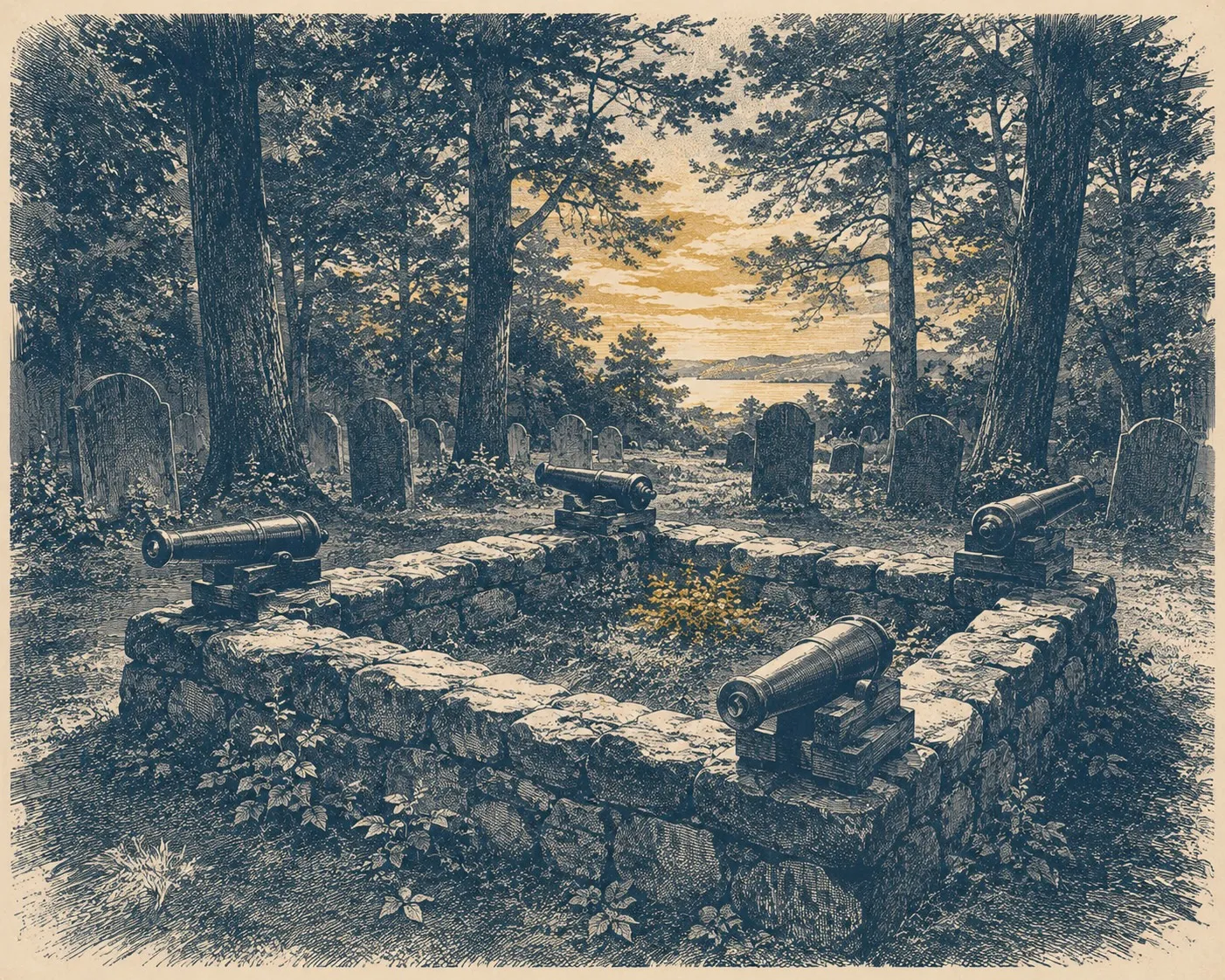
The strangest true story in town, and unlike most of this page, every word of it is documented. When the Duxbury Rural Society reclaimed the overgrown Old Burying Ground in 1887, visitors immediately wanted to know where Myles Standish lay. Family tradition pointed to two rough pyramid-shaped fieldstones, and in April 1889, over real objections, the Society dug beneath them. They found the skeleton of an elderly man beside a young woman, and no proof of anything. The Society's own president wrote that nothing was found to show the man was Standish. The graves were closed.
It did not stay settled. A newly arrived Episcopal minister, Rev. Eugene Huiginn, became convinced the dig had been too timid, and in 1891 he got permission to open the ground again, this time uncovering four sets of remains and declaring the question answered. The affair split the town. The Rural Society voted to wash its hands of the whole matter, two dozen members quit in protest and founded a rival historical society, and the splinter group raised $364 to build the cannon-cornered monument that marks the grave today, completed in 1893. The rivals eventually reunited, which is why the organization is now called the Rural and Historical Society.
And then it happened once more. In 1931, forty years after the diggings he had opposed from the start, an elderly Frederick Bradford Knapp watched the grave opened a third time, so the remains could be moved from a plain pine box into a sealed copper box inside a concrete vault. Whoever lies beneath the cannons, he has been disturbed three times and is now very thoroughly locked in.
“Speak for yourself, John”
The tale as the whole country once knew it: the first winter at Plymouth takes Rose Standish, the Captain's wife, and when spring comes the gruff old soldier sets his heart on Priscilla Mullins, the loveliest of the survivors, orphaned by that same winter. But Standish is a man of the sword, not of speeches, so he sends his young friend John Alden, the fair-haired cooper with the gift of words, to plead his case for him. Alden goes, though he is quietly, hopelessly in love with Priscilla himself. He makes the Captain's proposal faithfully, every argument in its place. Priscilla hears him out, looks at him, and asks the question that outlived them all: “Why don't you speak for yourself, John?”
Standish takes the refusal like a wound, storms off to the Indian wars, and word comes back that he has been killed. Freed by grief, John and Priscilla wed. And at the wedding feast, in walks Myles Standish, alive after all, to forgive his friend and bless the match. Curtain.
What the record shows: John Alden and Priscilla Mullins were real, they really married, and roughly half of old New England descends from them. Everything else, the errand, the question, the false death, comes from Longfellow's 1858 poem, published 230 years after the fact, and the documents are silent on all of it. We took the whole tale apart, line against ledger, in The Courtship of Myles Standish: legend vs. record. The chart below is the short version, and the house method for this entire page.

The guest who never checked out
The old farmhouse on Congress Street went up in 1741, and by the twentieth century it belonged to Lysander Walker, a recluse who kept to the house and let the world go by without him. He died there, alone, in 1928, and in the darker tellings he died by his own hand. The house passed on, and eventually became the restaurant every local knows as the Sun Tavern. That is when the stories started.
Staff closing up alone hear footsteps in empty rooms overhead. Cold spots settle over certain tables on warm nights. Doors that were latched are found open, and small things move when no one is watching. The regulars will tell you it is Lysander, still keeping to his house, mildly puzzled by all the company, and some add a sadder pair of housemates: two little girls, lost to scarlet fever back in the 1700s, heard now and then where no children are. The restaurant has long since made its peace with all of them. Ask your server. Most have a story, and October is the best month to hear it.
What the record shows: the house and Walker's death there are real; the rest is tradition, collected from the restaurant's own lore and published haunted-places compilations, and offered as exactly that. The companion piece to this story is documented and stranger: Myles Standish's grave was opened three separate times between 1889 and 1931, and the digging tore the town's historical society in two. That one is told in full above, in The captain who would not stay buried.
The storm the town still tells
On the Saturday after Thanksgiving, 1898, the steamer Portland left Boston for Maine into a sky that every old sailor on the wharf knew was wrong. Two storms were merging off the coast, and when they came together they made the worst gale New England had seen in living memory. Somewhere off Cape Cod that night, the Portland and every soul aboard her, nearly two hundred of them, went to the bottom. When the bodies came ashore on the outer beaches, the watches in their pockets had all stopped between nine and ten.
On this shore the gale wrecked dozens of vessels, smashed the Duxbury pier, and tore the beach open. A developer had just built three fine model homes out on the barrier beach to prove to buyers that a man could live grandly on the sand. The sea removed all three in a single night, and the town took the point: the beach association that still guards Duxbury Beach today was born from that lesson. Up the coast the storm cut the North River a new mouth and turned part of Scituate into an island, which sounds like folklore and is simply true.
For a generation afterward, South Shore grandparents told the Portland Gale the way other places tell ghost stories, because it nearly was one, and sailors swore the lost steamer herself could be glimpsed off the coast on rough November nights, still making for Maine. The record stops at the wreck. The legend, as usual, kept going.
The atmosphere is real
Verifiable hauntings or not, Duxbury after dark comes by its mood naturally. The Old Burying Ground at dusk, holding Mayflower passengers under bare trees, is as evocative a place as New England offers. The bay goes black and silent off the bridge on a November night. And fog coming over the barrier beach can erase the modern world entirely. Every town has ghost stories; not every town has scenery that makes them plausible.
Add to the pile
Every story on this page survived because somebody repeated it. Got one of your own, a family story, an unexplained night on the beach, a house that never felt quite empty, a legend you grew up on that we have missed? Send it in. The good ones get chased down, and the best ones get added here.
Sources & verification
The Webster story is drawn from Thoreau's journal entry of June 1857 and Stephen Vincent Benét's later short story, and is presented as the secondhand tale it has always been. The Wiswall stone and the town marker's fruit-and-flowers caveat are documented by the Duxbury historical marker program. The Hannah Thomas material combines her documented service at Plymouth Light with ghost accounts from published lighthouse-lore collections, which are anecdote, not evidence. The Standish sword hangs at Pilgrim Hall; the will's Lancashire claim is quoted from the probate record; the failed inheritance hunts are family tradition. The courtship tale follows Longfellow, against a silent record. The Sun Tavern material comes from the restaurant's own lore and haunted-places compilations. Portland Gale facts follow the standard historical accounts. Nothing on this page labeled a legend should be cited as fact, and that is rather the point. The Standish grave exhumations of 1889, 1891, and 1931 are documented history, drawn from the Duxbury Rural & Historical Society and from Historical Digression's detailed account of all three openings and the Society schism that followed. Last verified: July 22, 2026.

Astrology
Twelve signs read fresh each month, with a South Shore accent.

The courtship, fact-checked
Longfellow made Duxbury's founders famous. What the record shows about Standish, Alden, and Priscilla.
Wrecks & rescues
The shipwrecks of Duxbury Beach and the Gurnet, every entry sourced.