The stories that refuse to die.
A United States senator who swore he saw a sea serpent off this coast. A Pilgrim minister buried under a gravestone carved with tentacles. A lighthouse keeper who may still be at her window two centuries on. None of these stories needs to be true. They only need to be told, and Duxbury has been telling them for three hundred years.
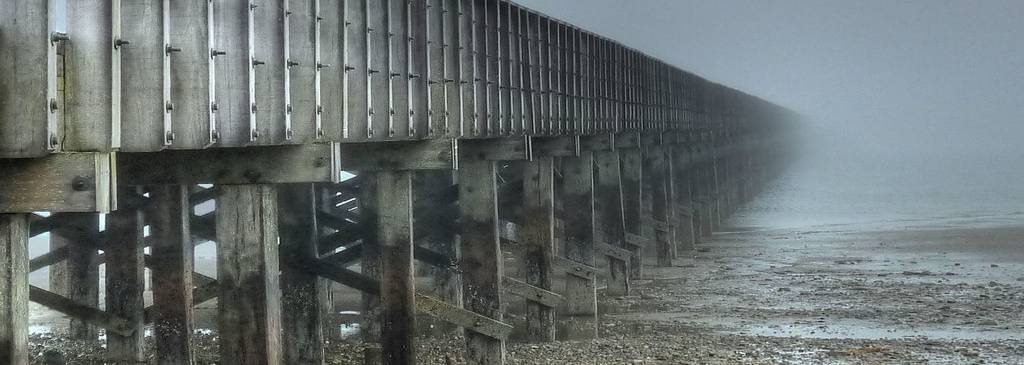 Fog on the Powder Point Bridge, prime legend weather · photo joiseyshowaa / CC BY-SA
A note on the rules of this page. Everything below is offered as what it is: legend. Where the historical record actually says something, we tell you what it says. Where it goes silent, we tell you that too, and then we tell the story anyway, because a town without its ghost stories is just a zip code. If you want the fully documented version of Duxbury's past, that lives on the History page. This page is for everything the documents cannot vouch for.
The senator and the sea serpent
Daniel Webster, the most famous orator in America, kept his farm one town up in Marshfield and fished these waters constantly with his boatman, a Duxbury man named Seth Peterson. In June 1857, Henry David Thoreau sat down in Plymouth and recorded in his journal a story he had just been told: that Webster, sailing back to Duxbury after a day of fishing off Manomet, saw the sea serpent.
The creature already had a local reputation. Thoreau's informant said it had first been spotted in the bay by a reliable old-timer who scanned the water with his glass every morning: a head somewhat like a horse's raised six feet above the surface, a body the size of a cask trailing behind, careering across the bay after mackerel so terrified they ran ashore and died in heaps. Webster's sighting, the story went, matched the common account exactly. And in the versions that circulated afterward, Webster turned to his companion and begged him to keep the whole thing quiet, on the theory that no one lets a man argue constitutional law after he has gone on record about a sea monster.
The story proved too good to stay local. The writer Stephen Vincent Benét, who made Webster famous all over again in "The Devil and Daniel Webster," wrote a companion tall tale called "Daniel Webster and the Sea Serpent," in which the creature follows the great man home and falls hopelessly in love with him. So the official record holds one secondhand journal entry from Thoreau, and the legend holds everything else. Watch the water off the beach on a flat calm evening and decide for yourself which one you believe.
The tentacles on the minister's gravestone
In the Old Burying Ground, the second-oldest carved stone belongs to Rev. Ichabod Wiswall, pastor of the Duxbury church, who died in 1700. Wiswall was a serious man. He sailed to London with Increase Mather to argue for the colony's charter. His gravestone is not serious. Across the top of it swim carvings that look, to nearly everyone who sees them, like squids. Tentacled, wide-eyed sea creatures, keeping watch over a Puritan minister a mile from the ocean.
The official interpretation, printed on the town's own historical marker, allows that the figures are "more likely representations of common fruits and flowers." Nobody who has stood in that graveyard at dusk has ever fully believed the fruit theory. Local lore prefers the obvious reading: a minister of a seafaring town went to his rest under the creatures of the deep, and the carver knew exactly what he was doing. Lovecraft fans make quiet pilgrimages to it. The stone has been called Duxbury's own little piece of the mythos, three centuries before anyone wrote the mythos down.
The keeper who never left the light
Walk the barrier beach far enough south and you reach the Gurnet, the high bluff at the very tip where the twin-towered Plymouth Light was built in 1769 on the farm of John and Hannah Thomas. When the Revolution came, John marched off to war and died of smallpox. Hannah stayed and kept the lights burning through British bombardment and winter gales, which made her the first woman lighthouse keeper in America. Neighbors said she could be seen at the window, watching the water for a husband who was never coming home.
The legend says she is watching still. Guests at the keeper's house have reported a sad-faced woman appearing at the window and, in one much-repeated account from 1994, the upper half of a ghostly figure hovering over the bed at night. The Gurnet technically sits across the Plymouth line, but the only road to it is Duxbury sand, and the light has anchored the view from this town's beach for 250 years. If Duxbury has a resident ghost of national standing, she is it.
The captain's mystic sword
Longfellow armed Myles Standish with a "trusty sword of Damascus, curved at the point and inscribed with its mystical Arabic sentence," and for once the poet was barely exaggerating. A sword said to be Standish's hangs in Pilgrim Hall in Plymouth, and it is a strange object by any standard: an old blade engraved with the sun, the moon, and the stars, carrying an inscription that generations of visitors were told no one in Plymouth could read. Victorian tourists treated it as half relic and half talisman, a magic sword owned by a Pilgrim.
The Captain left a second mystery in writing. In his 1656 will, drafted here in Duxbury, Standish claimed enormous ancestral lands in Lancashire as "right heir by lawful descent," lands he said had been "surreptitiously detained" from him. Swindled, in other words, out of an English fortune. For two centuries afterward his descendants chased the lost Standish inheritance through English records and courtrooms, and never recovered an acre. Whether the fortune ever existed is exactly the kind of question this page lives for. The full documented story of the man is in Myles Standish, the soldier.
“Speak for yourself, John”
The most famous legend ever attached to this town is the love triangle: Standish sends young John Alden to court Priscilla Mullins on his behalf, and Priscilla answers with the most celebrated comeback in colonial history. It comes from Longfellow's 1858 poem, it made Duxbury's founding families into national celebrities, and the historical record is completely silent on whether any of it happened. We took the whole thing apart, line against ledger, in The Courtship of Myles Standish: legend vs. record. The chart below is the short version.

The grave dug three times, and the guest who stayed
Two of the town's best strange stories have their own page. The first is documented and stranger for it: Myles Standish's grave was opened three separate times between 1889 and 1931, and the digging split the historical society in two. The second is pure tradition: the 1741 farmhouse that houses the Sun Tavern is said to be kept company by Lysander Walker, the recluse who died there in 1928 and, by all accounts, never checked out. Both stories, sorted and sourced, are in Duxbury after dark.
The storm the town still tells
Some legends started as weather. On the night of November 26, 1898, two storms merged off Virginia and came up the coast as the Portland Gale, the worst New England sea disaster of the nineteenth century. The steamer Portland went down with everyone aboard; when the bodies came ashore, the recovered watches had all stopped between nine and ten. Along this shore the gale wrecked dozens of vessels, damaged the Duxbury pier, tore up the beach, and destroyed the three model homes a developer had just built on the barrier beach to sell buyers on the idea of living out there. The beach association that still protects Duxbury Beach today was born from that lesson.
Up the coast the storm cut a river a new mouth and turned part of Scituate into an island, which is the kind of thing that sounds like folklore and is simply true. For a generation afterward, South Shore grandparents told the Portland Gale the way other regions tell ghost stories, and sailors claimed the lost steamer could be seen off the coast on rough November nights. The record stops at the wreck. The legend, as usual, kept going.
Add to the pile
Every entry on this page survived because somebody repeated it. Got one of your own, a family story, an unexplained night on the beach, a house that never felt quite empty, a legend you grew up on that we have missed? Send it in. The good ones get chased down, and the best ones get added here.
Sources & verification
The Webster story is drawn from Thoreau's journal entry of June 1857 and Stephen Vincent Benét's later short story, and is presented as the secondhand tale it has always been. The Wiswall stone and the town marker's fruit-and-flowers caveat are documented by the Duxbury historical marker program. The Hannah Thomas material combines her documented service at Plymouth Light with ghost accounts from published lighthouse-lore collections, which are anecdote, not evidence. The Standish sword hangs at Pilgrim Hall; the will's Lancashire claim is quoted from the probate record; the failed inheritance hunts are family tradition. Portland Gale facts follow the standard historical accounts. Nothing on this page labeled a legend should be cited as fact, and that is rather the point. Last verified: July 21, 2026.